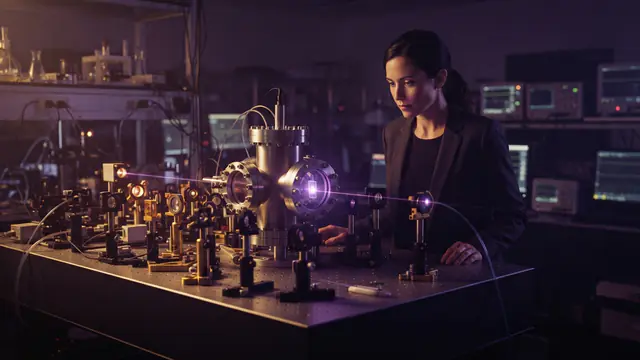
Ultrafast Light Pulses Track Molecular Motion at Three Femtoseconds
A newly developed UV-pump and XUV-probe platform captures the rapid transition of electrons and nuclei through conical intersections.
In short
- An international team led by Politecnico di Milano achieved a 3-femtosecond temporal resolution to observe molecular changes immediately following light absorption.
- The experimental platform uses synchronized ultraviolet pump pulses and attosecond extreme ultraviolet probe pulses.
- Measurements on acetylacetone successfully separated two sequential crossings through a conical intersection for the first time.
- The research was funded by the European Research Council under the ERC Synergy TOMATTO project and published in Nature Communications.
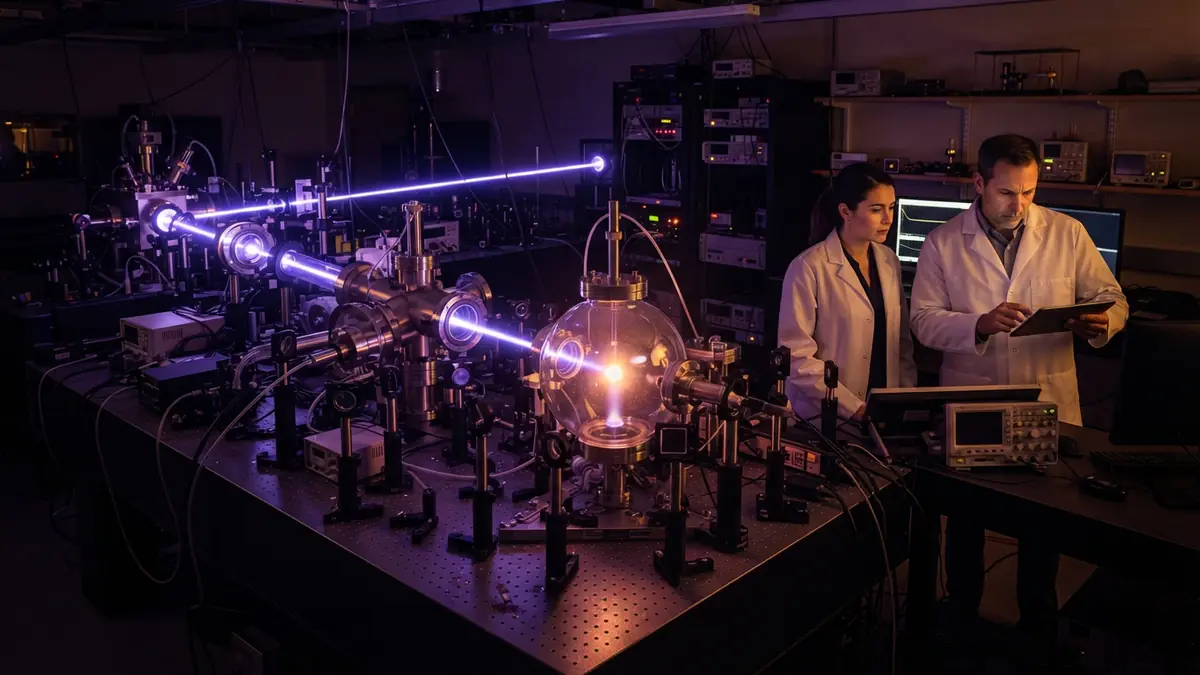
An international research team led by the Politecnico di Milano has tracked the coordinated motion of electrons and atomic nuclei immediately after light absorption with a temporal resolution of approximately three femtoseconds. Reported in Nature Communications, the experiment tracks the coordinated motion of electrons and nuclei in the gas phase. A single femtosecond equals one millionth of one billionth of a second, representing the timescale on which photo-induced molecular behavior unfolds.
The project was carried out under the European Research Council's ERC Synergy TOMATTO initiative, bringing together researchers from the Politecnico di Milano, the Institute for Photonics and Nanotechnologies of the CNR, Heriot-Watt University in Edinburgh, and the University of Bologna. By constructing a custom beamline, the team captured transient intermediate stages that earlier instruments could not isolate.

Capturing Molecular Motion with Three-Femtosecond Precision
When a molecule absorbs light, the experiment tracks the redistribution of energy and the joint motion of electrons and nuclei. Capturing this ultrafast molecular motion requires instrumentation capable of taking snapshots at intervals of just a few femtoseconds. Until now, existing time-resolved photoelectron spectroscopy tools lacked the time resolution needed to distinguish successive electronic passages.
"With this apparatus, we can follow a molecule in the very first instants after it absorbs light, with a level of detail that was not previously accessible," said Mauro Nisoli, a professor in the Department of Physics at the Politecnico di Milano and coordinator of the ERC Synergy TOMATTO project, in an announcement from Politecnico di Milano. Nisoli compared the capability to dramatically increasing the frame rate of a video recording, exposing intermediate transitions inside an event previously viewed as a single step.
How the UV-Pump and XUV-Probe Beamline Operates
The experimental system relies on a two-pulse pump-probe architecture configured to run with tight synchronization. The first pulse operates in the ultraviolet (UV) spectrum, where photon absorption excites the target molecule and initiates its structural evolution. After a precise, variable delay, a second probe pulse strikes the molecule.
The probe pulse operates in the extreme ultraviolet (XUV) range and lasts only a few attoseconds. The extreme ultraviolet pulse makes it possible to reconstruct the molecule's state at that precise moment using photoelectron spectroscopy. By adjusting the delay between the UV pump and XUV probe across tiny intervals, the team can map the redistribution of energy and the coupled motion of electrons and nuclei as reported by Phys.org.
Maurizio Reduzzi, an associate professor at the Politecnico di Milano, noted that tracking these initial moments provides direct observation of the point where photochemical transformations take shape.
Revealing Conical Intersections in Acetylacetone
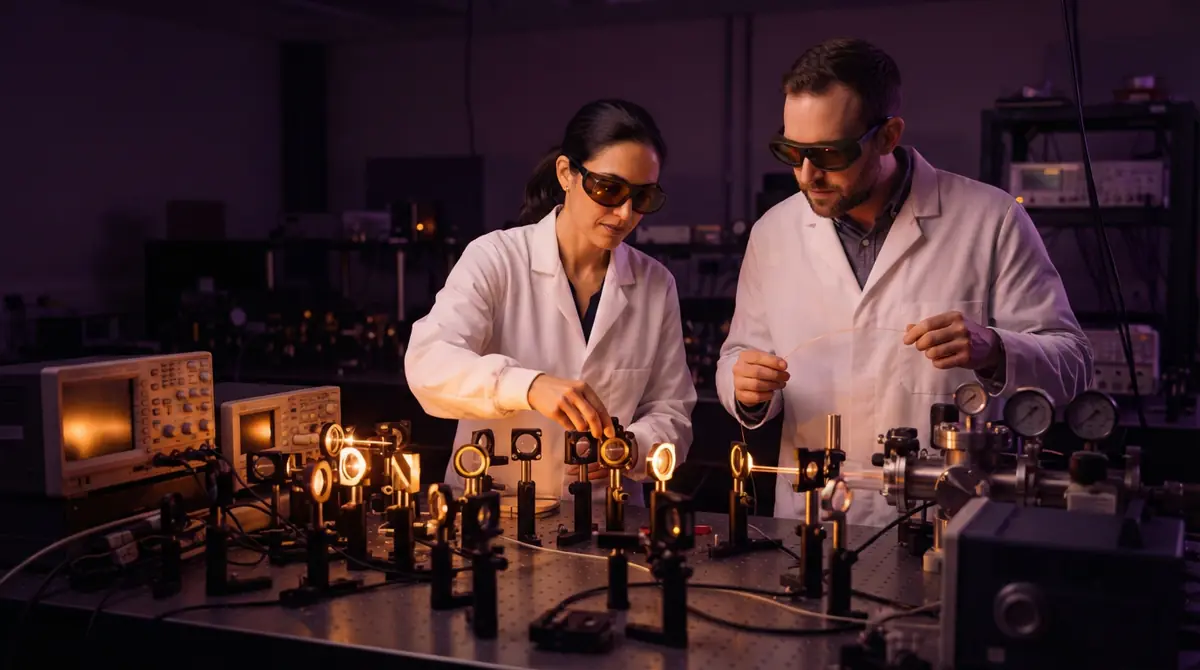
To test the apparatus, the researchers examined acetylacetone in the gas phase, a standard benchmark molecule used in photochemistry. Following UV excitation, acetylacetone undergoes rapid deactivation. The platform's 3-femtosecond temporal resolution enabled the team to distinguish two successive passages through a conical intersection.
A conical intersection is a crucial junction at which the molecule changes electronic state and is directed toward a specific transformation pathway. Previous experimental instruments lacked the speed to isolate these two distinct crossings in acetylacetone, obscuring the order and timing of the intermediate transitions according to EurekAlert.
Applications for Photochemistry and Attochemistry
The beamline design allows researchers to tune the wavelength of the initial UV pulse, enabling the study of different target molecules and excited states beyond acetylacetone. The researchers noted that this adaptability makes the platform relevant for investigating larger, more intricate molecular frameworks, such as biological systems, photoactive materials, and processes linked to energy conversion.
Beyond observational photochemistry, the methodology supports emerging investigations in attochemistry. Attochemistry focuses on observing and ultimately directing chemical transformations by steering the movement of electrons before atomic nuclei have time to move. By establishing direct measurement capabilities at the 3-femtosecond limit, the research team provides an experimental baseline for studying how light-driven reactions initiate across fundamental physical systems.
Questions people ask
What is the significance of a three-femtosecond temporal resolution?
A femtosecond is one quadrillionth (one millionth of one billionth) of a second. Achieving a three-femtosecond resolution allows researchers to capture the rapid shifting of electrons and atomic nuclei immediately after light absorption, revealing intermediate steps that were previously blurred together.
How does the pump-probe apparatus work?
The setup uses an ultraviolet (UV) pulse to excite the molecule and start the photochemical process, followed by an extreme ultraviolet (XUV) pulse lasting a few attoseconds. The XUV pulse releases photoelectrons, allowing researchers to measure the molecule's physical state at controlled delay times.
What molecule was examined in the study?
The team studied acetylacetone in the gas phase, using it as a model system to demonstrate the ability to distinguish two sequential crossings through a conical intersection.
Who led the research project?
The project was led by the Politecnico di Milano in collaboration with the CNR Institute for Photonics and Nanotechnologies, Heriot-Watt University, and the University of Bologna, funded by the ERC Synergy TOMATTO project.
Sources
- Ultrafast light pulses track molecular motion with three-femtosecond resolutionPhys.org, Oct 22, 2026
- Detail - polimipolimi.it
- Three femtoseconds to observe a molecule as it changesEurekAlert!
How this story was made: the newsroom picked it up from phys.org, gathered the full text of the sources above, and drafted it with AI assistance. Every factual claim was then checked against those sources before publishing (31 claims checked). Illustrations marked as AI-generated are not photographs. Spotted an error? Tell us.
Published October 23, 2026 at 03:38 UTC