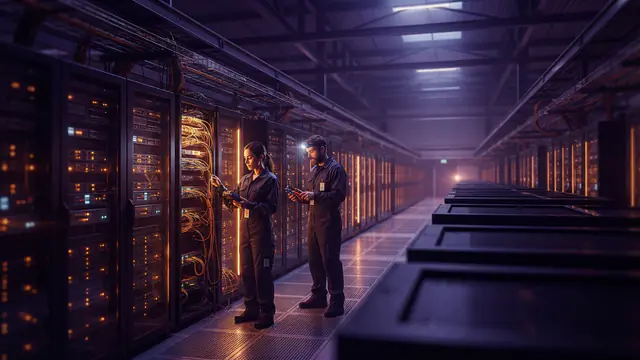
Nvidia Commits $1 Billion to Advance U.S. Science Research
The $1 billion commitment targets higher-education institutions, quantum computing, and cloud service providers supporting government needs, while the Genesis Mission is a separate federal initiative in which Nvidia collaborates.
Key takeaways
- Nvidia pledged commitments valued at $1 billion over the next five years to support U.S. scientific research.
- The initiative focuses on quantum computing, healthcare, energy security, and higher-education research institutions.
- The effort integrates with phase 2 of the federal Genesis Mission across fusion, accelerator design, and microelectronics.
- Nvidia is currently constructing the Department of Energy's largest scientific supercomputer at Argonne National Laboratory.
Nvidia announced commitments valued at $1 billion over five years to build out research and development capacity for scientific computing across the United States. Unveiled on October 8, 2026, at the Science: A New Golden Age event in Washington, D.C., the initiative aims to support higher-education research institutions, quantum computing, and cloud service providers bolstering U.S. government needs. According to Nvidia's announcement, the funding targets domains critical to U.S. technical leadership, specifically quantum computing, healthcare, and energy security.
Speaking at the Washington gathering, Nvidia founder and chief executive Jensen Huang linked the pledge directly to federal technology programs. "President Trump’s Genesis Mission is launching a new golden age of American discovery," Huang stated. "With a $1 billion investment, NVIDIA is putting advanced Super Intelligence in the hands of America’s scientists to accelerate breakthroughs in medicine, energy and materials. This is how America turns scientific leadership into industrial leadership, and innovation into jobs and opportunity for generations."
Allocation of the Five-Year Scientific Commitment
The $1 billion commitment spans three primary operational categories, as reported by The Next Web. Nvidia will provide compute and infrastructure resources to higher-education research institutions, invest directly in accelerating domestic quantum computing research, and support cloud service providers that meet U.S. government operational requirements. The company has not publicly released a specific financial breakdown among those three recipients.
In tandem with the financial commitment, Nvidia issued an open invitation to researchers across the scientific community. The company stated that scientists will be able to access its compute and super intelligence infrastructure to accelerate research and development workflows. As noted by Morningstar, the investment will focus on building out U.S. research and development capacity in quantum computing, healthcare, and energy security to help the U.S. gain an edge.

Deepening Federal Ties Through the Genesis Mission
At the event, the U.S. Office of Science and Technology Policy celebrated and marked the expansion of the Genesis Mission. An executive order established the Department of Energy-led Genesis Mission program in November 2025, with Nvidia serving as a primary industry partner, according to The Next Web.
During the Washington event, phase 2 Genesis Mission awards were announced. Nvidia confirmed that it is actively collaborating on several of these awarded projects, covering microelectronics, accelerator design, nuclear fusion, and quantum computing. Financial analysis from 24/7 Wall St. noted that these awards embed Nvidia’s computing architecture across strategic research sectors prioritized by the federal government.
Longstanding National Laboratory Deployments
Nvidia's five-year pledge builds on more than two decades of formal collaboration with U.S. national laboratories, as detailed by StreetInsider. In 2025, Nvidia and the Department of Energy announced a joint initiative under the Genesis Mission to build the agency's largest supercomputer for scientific research, located at Argonne National Laboratory.
Beyond the primary Argonne system, Nvidia is supporting seven additional computing installations across Argonne and Los Alamos National Laboratories. Recent laboratory engagements cited by The Next Web include a July 2026 donation of a DGX GB300 system to the Naval Postgraduate School and a September 2026 quantum project at Fermilab, where Nvidia quantum software reduced design work from five months to three weeks.
Frequently asked questions
What areas will the Nvidia $1 billion commitment fund?
The commitments will fund U.S. higher-education research institutions, domestic quantum computing development, and cloud service providers supporting government mission requirements, with an emphasis on energy security, healthcare, and quantum research.
What is the Genesis Mission mentioned in the announcement?
The Genesis Mission is a U.S. federal research program led by the Department of Energy, established by an executive order in November 2025. Nvidia is an industry partner collaborating on phase 2 projects in fusion, microelectronics, accelerator design, and quantum computing.
Which national laboratories currently deploy Nvidia supercomputing hardware?
Nvidia is building the Department of Energy's largest scientific supercomputer at Argonne National Laboratory and supports seven additional computing systems across Argonne and Los Alamos National Laboratories.
Sources
- NVIDIA Commits $1 Billion to Advance US Science Over the Next Five YearsNVIDIA Newsroom · Official
- Nvidia commits $1bn to US science over the next five yearsTNW | Nvidia · Oct 8, 2026
- Nvidia to Invest $1 Billion in U.S. Science Over Next 5 YearsMorningstar, Inc. · Oct 8, 2026
- NVIDIA Locks In $1 Billion for US Science Over Five Years24/7 Wall St. · Oct 8, 2026
- Nvidia pledges $1 billion to U.S. science research over five yearsstreetinsider.com · Oct 8, 2026
How this story was made: the newsroom picked it up from Google News and Techmeme, gathered the full text of the sources above, and drafted it with AI assistance. Every factual claim was then checked against those sources before publishing (17 claims checked). Illustrations marked as AI-generated are not photographs. Spotted an error? Tell us.
Published October 10, 2026 at 00:19 UTC