Trapped-Ion Quantum Simulator Recreates Particle-Forming String Breaking
A 13-ion trapped-ion processor observed simulated matter appear from stored energy, mirroring subatomic processes from the early universe.
Key takeaways
- Physicists at the Duke Quantum Center used a 13-ion trapped-ion quantum simulator to recreate string-breaking dynamics in real time.
- The simulation mapped a simplified one-dimensional gauge theory onto ytterbium ions, demonstrating how tension between charges forces new particle pairs to appear.
- Rather than uniform Schwinger pair production, the experiment revealed an edge-facilitated mechanism where pairs formed near the string ends and moved inward.
- Parallel string-breaking benchmarks have also been achieved across neutral-atom arrays and superconducting processors by QuEra and Google.
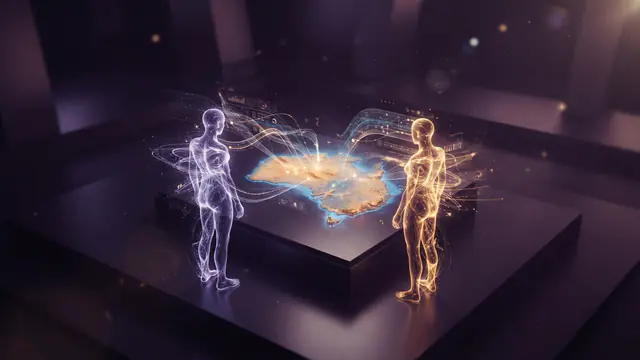
Physicists led by the Duke Quantum Center have demonstrated the formation of simulated particle-antiparticle pairs on a trapped-ion quantum computer, mimicking subatomic processes that take place under extreme conditions like those in the early universe. Published on September 23, 2026, in Nature Physics, the study tracked real-time "string breaking"—the fundamental mechanism where energy stored between separating quarks converts directly into new matter—using a controllable chain of 13 trapped ytterbium ions. Details of the breakthrough were published by the Duke Pratt School of Engineering.
The research represents a collaboration between Duke University, the University of Maryland, Oxford University, the California Institute of Technology, Cornell University, and KU Leuven. By programming subatomic force models directly into trapped ions, the team showed how quantum hardware can simulate non-equilibrium quantum field dynamics that quickly overwhelm traditional binary processors.
The Physics of Quark Confinement and String Breaking
In fundamental physics, quarks are the building blocks of hadrons such as protons and neutrons, measuring roughly a billion times smaller than an atom. Under quantum chromodynamics (QCD), isolated quarks cannot be observed directly because color confinement holds them together, as explained in coverage by ScienceDaily.
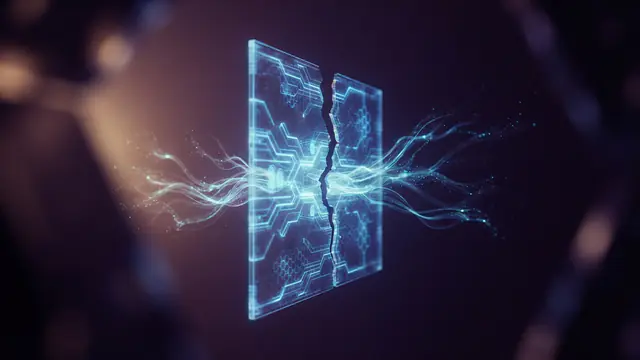
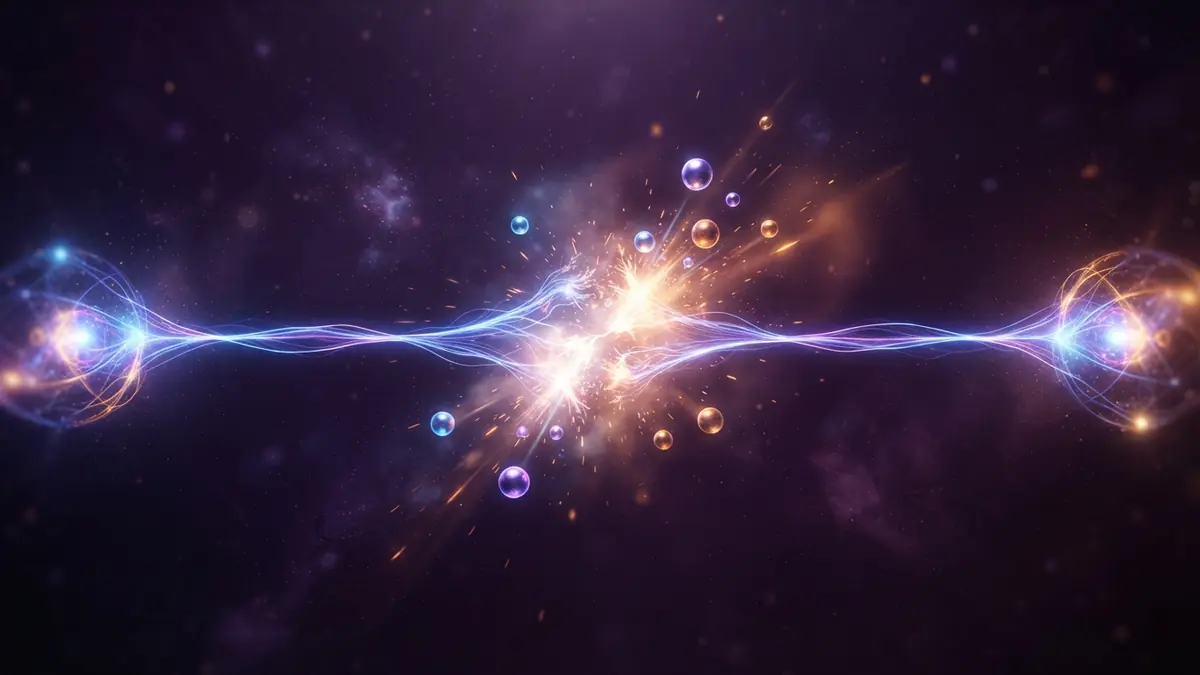
When two confined quarks are pulled apart, their interaction does not fade with distance. Instead, the gluonic field connecting them behaves like an elastic string, accumulating vast amounts of potential energy. Once the energy density crosses a critical threshold, it becomes energetically cheaper for the connection to snap than to stretch further. Governed by Einstein's mass-energy equivalence ($E=mc^2$), that stored energy transforms directly into a new pair of particles, yielding two shorter bound pairs instead of an isolated quark. In the natural world, this behavior occurs only in high-energy collisions within particle colliders like the Large Hadron Collider or during the extreme aftermath of the Big Bang.
Simulating how these strings evolve over time has historically posed severe computational hurdles. While classical supercomputers can compute static properties of gauge theories, calculating non-equilibrium, real-time dynamics involves complex entanglement that scales exponentially beyond the capacity of binary memory.
How 13 Trapped Ions Recreated Subatomic Dynamics
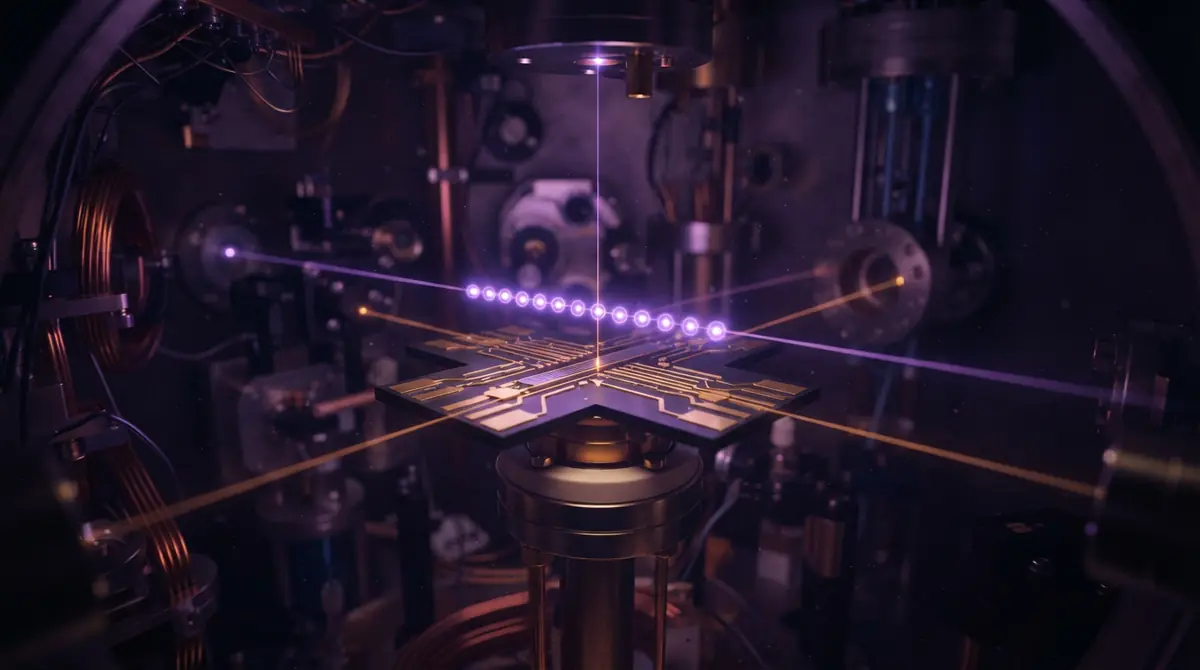
To recreate the string-breaking process in a lab, the Duke-led team used a programmable trapped-ion quantum simulator. The experimental setup and its theoretical foundation were detailed in a report by The Brighter Side of News. Rather than simulating full three-dimensional quantum chromodynamics, the physicists encoded a one-dimensional lattice gauge theory mapped onto a quantum Ising spin model.
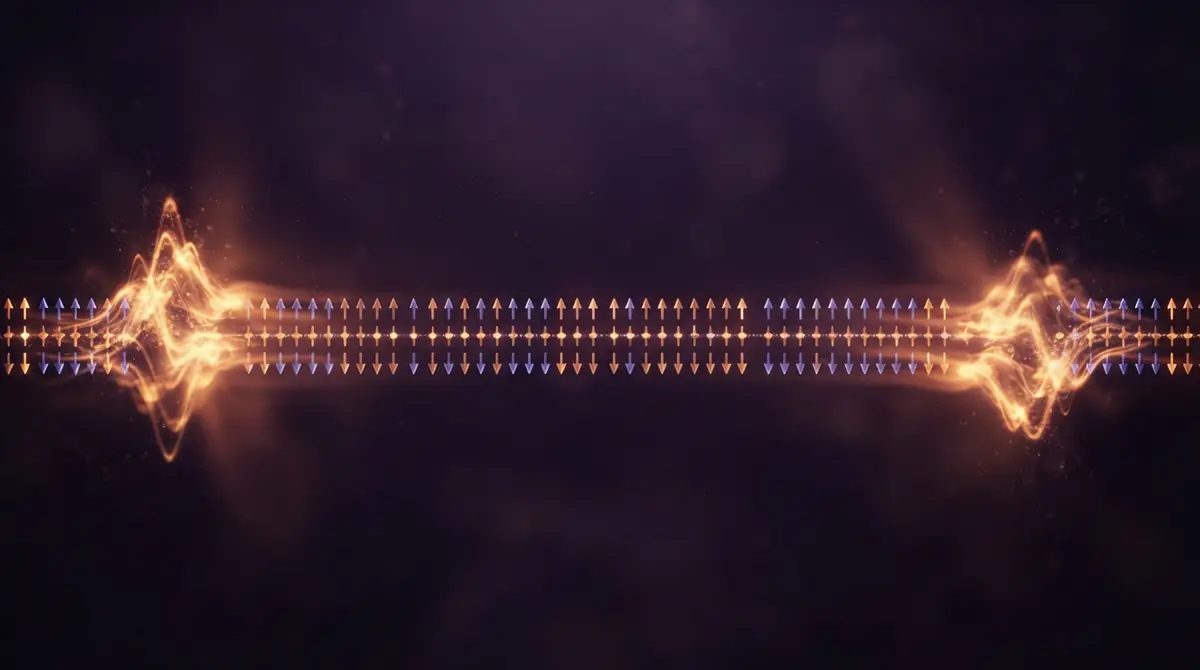
The system held 13 ytterbium ions inside a trap, using two internal states of each ion to represent quantum spins. In this mapping, simulated charges correspond to boundaries between oppositely oriented spins, while the string itself corresponds to a continuous domain of aligned spins.
By directing arrays of precisely tuned laser beams at the ions, the physicists adjusted the interactions between individual qubits and varied effective local magnetic fields. This laser control allowed the researchers to represent not only the active simulated region but also virtual surrounding environments at the edges of the 13-ion chain. These engineered boundary conditions allowed a compact 13-ion setup to emulate the physical effects of a much wider surrounding system.
Observing Edge-Driven Particle Emergence
To start the simulation, researchers placed static effective charges at opposite ends of the chain, establishing an initial string state, and then abruptly altered the system's operational parameters. This quench injected energy and drove the quantum state far out of equilibrium, initiating real-time string dynamics.
Tracking the quantum system as it evolved revealed an unexpected behavior. Standard theoretical models, such as the Schwinger mechanism, predict that spontaneous pair creation occurs uniformly throughout a sufficiently intense field. Instead, the trapped-ion experiment observed pairs repeatedly appearing at the outer edges of the string.
Under lower string tension, the newly formed charge pairs remained localized near the boundaries and engaged in coherent oscillations. As researchers increased the string tension, the pairs began migrating inward toward the center of the chain. The authors formulated a theoretical model explaining that creating pairs near the edges initially demands less energy because of the vacuum conditions built into the simulation boundaries. Because the onset of this behavior showed minimal sensitivity to parameter variations, the team classified it as an edge-facilitated string-breaking mechanism distinct from standard Schwinger production.
To verify the results, the researchers ran identical simulations on classical computers, according to IFLScience. The classical calculations closely matched the experimental data recorded from the ion trap, confirming that the quantum hardware behaved correctly.
Cross-Platform Validation Across Quantum Architectures
The Duke experiment coincides with independent efforts exploring string dynamics across alternative quantum architectures, as reported by HotHardware. Alongside Duke's trapped-ion demonstration, researchers led by Google investigated charge and string dynamics using superconducting qubits, while a team at QuEra Computing simulated string breaking in two dimensions using neutral-atom Rydberg arrays. Related work at Oak Ridge National Laboratory deployed 104 qubits on an IBM Heron superconducting processor via the Quantum Computer User Program (QCUP) to track evolving subatomic fields from a vacuum state.
"These are the three platforms leading the charge in quantum computing, so it's a nice benchmark and comparison for the quantum community," said Christopher Monroe, professor of electrical and computer engineering and physics at Duke University, who led the project.
Arinjoy De, first author of the paper and former doctoral student in Monroe's laboratory who now serves as production machine lead at QuEra Computing, emphasized the utility of the approach: "By simulating quark confinement and string-breaking phenomena in a controlled lab environment, we're opening up new pathways for experimental investigations into the behavior of matter at its most fundamental level."
Looking Ahead: Toward Complex Gauge Simulations
The 13-ion demonstration does not represent full quantum chromodynamics, which contains non-Abelian gauge fields and operates across three spatial dimensions. However, it establishes an experimental framework for studying non-equilibrium gauge theories on quantum hardware.
As qubit counts increase and hardware error rates decline, quantum simulators will be able to model moving dynamical charges, multi-dimensional lattices, and high-energy particle collisions that supercomputers cannot solve. Supported by the U.S. Department of Energy, the National Science Foundation, DARPA, the Air Force Office of Scientific Research, and Amazon Web Services, these systems are positioned to serve as computational testbeds that complement physical facilities like the Large Hadron Collider to probe early universe physics.
Frequently asked questions
What is string breaking in quantum physics?
String breaking is a phenomenon in subatomic physics where the strong nuclear force holding quarks together stores potential energy as they are pulled apart. When that energetic connection snaps, the energy converts directly into new particle-antiparticle pairs according to E=mc².
What hardware was used in the Duke Quantum Center experiment?
The researchers used a trapped-ion quantum simulator containing 13 ytterbium ions. Precisely focused laser beams tuned the quantum interactions between the ions to emulate a one-dimensional lattice gauge theory.
Did the quantum simulator outperform classical supercomputers in this test?
Not yet. For a 13-ion system, classical computers can still calculate the exact evolution to verify the quantum computer's accuracy. The experiment serves as a validated benchmark toward larger systems that will eventually exceed classical supercomputer capabilities.
How does the trapped-ion experiment compare to other quantum platforms?
Similar string-breaking dynamics have recently been tested across the three primary quantum architectures: trapped ions at Duke, neutral atoms at QuEra Computing, and superconducting processors at Google and IBM.
Sources
- Quantum computer simulates matter “popping into existence”ScienceDaily
- Quantum Device Simulates Matter Popping into ExistenceDuke Pratt School of Engineering · Sep 23, 2026
- Scientists Simulated How Matter Can Emerge From Pure Energy On A Quantum Computer | IFLScienceiflscience.com
- Quantum Computers Just Recreated How Matter Was Born In The Big BangHotHardware · Sep 25, 2026
- Quantum computer simulates how stored energy can become new particlesThe Brighter Side of News · Sep 25, 2026
How this story was made: the newsroom picked it up from sciencedaily.com, gathered the full text of the sources above, and drafted it with AI assistance. Every factual claim was then checked against those sources before publishing (28 claims checked). Illustrations marked as AI-generated are not photographs. Spotted an error? Tell us.
Published September 27, 2026 at 07:20 UTC