Tech Giants Pledge $2.4B in Compute for Federal Genesis Mission
Eleven technology leaders have committed computing credits and artificial intelligence tools to accelerate federally funded research across more than 15 agencies.

Key takeaways
- Eleven technology firms pledged $2.4 billion in computing credits and AI tools to the Genesis Mission Consortium during a White House summit on October 8, 2026.
- Nvidia led the commitments with $1 billion over five years, followed by AMD at $500 million, OpenAI at $200 million, and Anthropic and Google at $150 million each.
- The compute resources will support researchers across more than 15 federal agencies, targeting key disciplines such as quantum computing, fusion energy, and healthcare.
- The private-sector pledges are part of a broader $6 billion federal, academic, and philanthropic science package outlined by the White House Office of Science and Technology Policy.
On October 8, 2026, eleven prominent technology companies committed $2.4 billion in advanced computing tools and cloud credits to support the U.S. government's Genesis Mission. The commitments, announced during the Science: A New Golden Age Summit in Washington, D.C., are designed to supply researchers across more than 15 federal agencies with the infrastructure required to conduct artificial intelligence and super intelligence research. The White House presented the private-sector contributions alongside a wider package exceeding $6 billion in coordinated funding across federal agencies, industry, academia, and philanthropy, according to a White House fact sheet.
The Genesis Mission was initiated by President Donald Trump in November 2025 under the Department of Energy (DOE) before being broadened in July 2026 to span more than a dozen civilian and defense agencies, supported by a $5 billion federal funding commitment, according to MeriTalk and the White House fact sheet. The new $2.4 billion industry pledge channels compute directly into the Genesis Mission Consortium, an operational hub established in February 2026 to facilitate public-private technical collaborations.
Big Tech Unveils $2.4 Billion in Compute and AI Allocations
The private sector contributions to the Genesis Mission Consortium represent eleven individual corporate pledges spanning specialized hardware, cloud infrastructure, and frontier AI model access. MeriTalk confirmed the funding breakdown across the corporate partners:
- Nvidia: $1 billion in super intelligence infrastructure and computing capabilities over five years.
- AMD: $500 million in computing resources.
- OpenAI: $200 million in token discounts and specialized training programs for scientists.
- Anthropic: $150 million in access to Claude models and developer tools over three years.
- Google: $150 million in technology resources.
- AMP: $100 million in computing commitments.
- Emerald AI: $100 million in AI resources.
- Amazon Web Services (AWS): $50 million in cloud credits.
- Armada: $50 million in compute infrastructure.
- Crusoe: $50 million in computing credits.
- Micron: $50 million in technological resources.
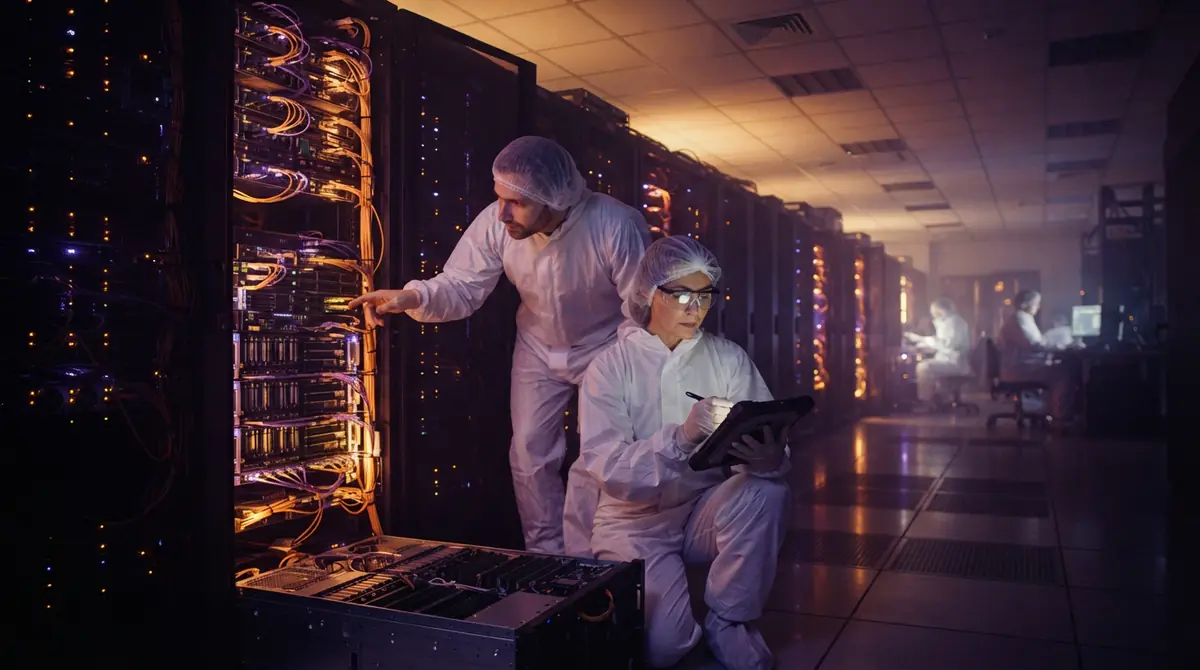
Nvidia’s $1 billion pledge represents the largest single corporate commitment. According to an official announcement from the Nvidia Newsroom, the company will direct its resources toward higher-education research institutions, quantum computing efforts, and cloud service providers supporting government mission requirements. Nvidia is also collaborating on Phase 2 Genesis Mission awards across microelectronics, particle accelerator design, fusion, and quantum computing. The company is actively constructing the DOE's largest scientific supercomputer at Argonne National Laboratory while supporting seven additional systems deployed across Argonne and Los Alamos National Laboratories.
"President Trump’s Genesis Mission is launching a new golden age of American discovery," Nvidia founder and CEO Jensen Huang said in a statement. "With a $1 billion investment, NVIDIA is putting advanced Super Intelligence in the hands of America’s scientists to accelerate breakthroughs in medicine, energy and materials."
Specialized Model Access and Cloud Allocations
Model developers and cloud platforms detailed specific delivery mechanisms for the pledged resources. In a published update from Anthropic, the company stated it will deliver Claude, Claude Code, and API credits to several hundred Genesis Mission research projects over three years. Anthropic's commitment will serve more than 15 federal entities, including NASA, the National Institutes of Health (NIH), and the National Science Foundation (NSF). The firm will also provide technical onboarding and direct engineering support to scientists working on fusion energy and quantum systems, following up on its earlier launch of Claude Science and a 10,000-seat academic access initiative.
OpenAI pledged $200 million in token discounts and training programs for scientists, as reported by The American Bazaar.
Cloud provider AWS announced the creation of the Golden Age of Science Accelerator, committing up to $50 million in cloud computing credits over three years. Under this program, eligible federal agencies and research partners can apply credits directly to existing contracts for approved projects aligned with national scientific priorities, according to MeriTalk.
"American scientists are on the cusp of breakthroughs that will define the next century — from accelerating biomedical research and improving health outcomes, to AI-driven drug discovery — but they need computing power at scale," David Appel, interim vice president of Worldwide Public Sector at AWS, said in a statement cited by Nextgov/FCW.

Federal Strategy and Agency Expansions
The industrial compute pledges coincide with sweeping federal programmatic rollouts managed by the White House Office of Science and Technology Policy (OSTP). OSTP Director Michael Kratsios authored the administration's strategic report, titled Science: A New Golden Age, which served as the blueprint for the summit. In the White House announcement, Kratsios described the package as an effort to channel billions of dollars across the research ecosystem to empower super intelligence, install merit-based evaluation frameworks, and renew focused national scientific directives.
Several federal agencies introduced complementary research investments during the event:
- Department of Energy: Announced $159 million for 12 new Phase II Genesis Mission awards targeting fusion energy, quantum computing, semiconductor design, and scientific software, alongside $96 million for early-career investigators and graduate fellowships, as documented by Nextgov/FCW. The DOE also outlined the Quantum Genesis Q Competition, a $215 million effort targeting fault-tolerant quantum computers across eight defined challenge problems.
- Department of Defense: Allocated up to $350 million for quantum computing defense initiatives and introduced an enterprisewide laboratory efficiency framework. Undersecretary of Defense for Research and Engineering Emil Michael stated the Pentagon is working to dismantle commercialization barriers and protect taxpayer-funded research from foreign exploitation.
- National Science Foundation: Announced two $33 million Grand Research Challenge prize competitions in synthetic multicellularity and Quantum+X applications, while joining the DOE to invest over $100 million in autonomous laboratories and scientific instrumentation.
- NASA and DOE Partnership: Executed a memorandum of understanding to construct space nuclear systems, including Space Reactor-1—a nuclear-powered Mars spacecraft targeting a 2028 launch—and Lunar Reactor-1, planned as the first fission reactor on the Moon's surface.
- Biomedical Research: The NIH, DOE, and Biohub launched a $1.8 billion virtual biology initiative to build foundations for virtual cells, supporting the administration's Bio Genesis mission to double the pace of biomedical innovation.
Implementation Through the Genesis Mission Consortium
The private-sector commitments are routed through the Genesis Mission Consortium to streamline how federal researchers tap commercial compute power. Federal procurement requirements earlier in 2026 made private-sector partnership mandatory for large-team applications competing for a $293 million Genesis Mission award pool, according to reporting by FedScoop. Corporate partners formed the single largest category of participants in the initial 278 team awards granted in summer 2026, exceeding participation numbers from universities and national laboratories.
By pooling compute credits from hardware manufacturers like Nvidia and AMD, cloud providers including AWS and Crusoe, and model creators such as OpenAI and Anthropic, the consortium aims to lower logistical barriers for scientists across NASA, NIH, NSF, and national laboratories who require immense compute infrastructure to tackle high-complexity simulations and data analysis.
Frequently asked questions
What is the Genesis Mission?
The Genesis Mission is a U.S. federal initiative launched by the Trump administration in November 2025 to accelerate scientific research and technological innovation using artificial intelligence, super intelligence, and high-performance computing across more than 15 federal agencies.
Which company made the largest computing commitment?
Nvidia made the largest single commitment, pledging $1 billion over five years in super intelligence infrastructure and computing capabilities for scientific research institutions, quantum computing, and federal missions.
How will federal researchers access AI models like Claude?
Anthropic is providing $150 million over three years in Claude, Claude Code, and API credits, along with direct training and onboarding support, for several hundred research projects across agencies like NASA, the NIH, and the NSF.
Which federal agencies are receiving support under the initiative?
More than 15 federal agencies are participating in the expanded Genesis Mission, including the Department of Energy, NASA, the National Science Foundation, the National Institutes of Health, and the Department of Defense.
Sources
- NVIDIA Commits $1 Billion to Advance US Science Over the Next Five YearsNVIDIA Newsroom · Official
- Building on our commitment to American scientific discoveryAnthropic · Oct 8, 2026 · Official
- Fact Sheet: Trump Administration Announces the Most Ambitious Set of Science Initiatives This CenturyThe White House · Oct 8, 2026
- White House unveils billions in investments for Genesis MissionNextgov/FCW · Oct 8, 2026
- Tech Giants Commit $2.4B in AI, Computing Resources to Genesis Missionmeritalk.com
- Tech sector pours $2.4B in AI tools, compute credits for Genesis Mission ConsortiumFedScoop · Oct 8, 2026
- OpenAI, Nvidia, Anthropic, and others pledge $2.4B in computing resources for Trump’s Genesis MissionThe American Bazaar · Oct 9, 2026
How this story was made: the newsroom picked it up from Google Search and Google News, gathered the full text of the sources above, and drafted it with AI assistance. Every factual claim was then checked against those sources before publishing (22 claims checked). Illustrations marked as AI-generated are not photographs. Spotted an error? Tell us.
Published October 10, 2026 at 00:14 UTC