Sunrise-III Uncovers Intricate Magnetic Web Above the Sun's Quiet Regions
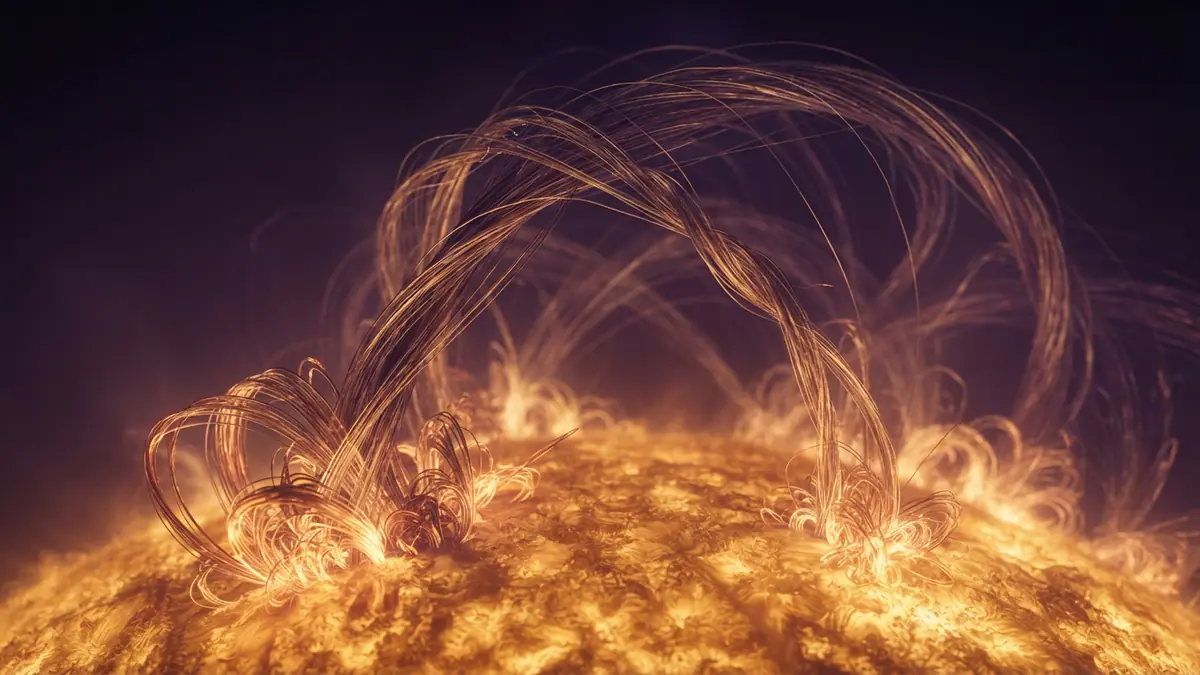
Stratospheric observations by the Sunrise-III balloon telescope reveal twisted, thread-like magnetic structures stretching across the Sun's calmest regions.
In short
- The balloon-borne Sunrise-III telescope identified a complex magnetic web of thin, thread-like features in the Sun's chromosphere.
- The structures were detected above quiet-Sun regions, which cover most of the solar surface and lack prominent features like sunspots.
- Computer simulations indicate that surface motions twist magnetic field lines, helping explain how energy transfers into the upper solar atmosphere.
An international research team led by the National Astronomical Observatory of Japan has uncovered a complex magnetic web of thread-like magnetic structures suspended above calm regions of the solar atmosphere. Detected using data gathered during the 2024 stratospheric flight of the balloon-borne Sunrise-III solar observatory, the findings show that even the quietest areas of our star harbor intricate, fine-scale magnetic architecture. Researchers reported the discovery in three papers published in The Astrophysical Journal Letters, with findings announced on NAOJ's official portal.
Quiet regions cover the majority of the solar surface and lack conspicuous features such as sunspots. While these zones appear tranquil from Earth, the Sunrise-III measurements demonstrate that their upper atmosphere is threaded with fine magnetic field lines that provide critical clues about how energy travels upward to heat the solar atmosphere.

Unveiling the Magnetic Web in the Chromosphere
The newly discovered structures reside within the chromosphere, the atmospheric layer directly above the Sun's visible surface, the photosphere. In solar physics, the transition zone where surface magnetic fields expand outward and arch upward is called the magnetic canopy. Scientists previously viewed this canopy as a relatively smooth, uniformly expanding boundary.
Sunrise-III showed instead that the canopy contains numerous narrow, thread-like substructures woven together into an elaborate network, as detailed by ScienceDaily. To investigate how these fine threads form, researchers ran numerical computer simulations reproducing the observatory's measurements. The simulations showed that motions at the solar surface twist magnetic field lines, which are associated with the thread-like structures observed higher in the atmosphere.
Beyond mapping the magnetic canopy, Sunrise-III conducted targeted measurements along the solar limb, the visible edge of the Sun. There, the team mapped magnetic fields within spicules—narrow jets of solar material that extend upward from the surface—revealing how the distribution of magnetic fields changes with height, according to ScienceDaily.

How Sunrise-III Observed from the Stratosphere
Studying magnetic behavior across the quiet Sun poses severe technical difficulties for Earth-bound instruments. Although the quiet Sun represents the dominant portion of the solar surface, its magnetic fields are weaker than in active regions. Ground-based solar observatories struggle to resolve these subtle features because turbulence in Earth's atmosphere blurs the view.
To overcome atmospheric distortion, the Sunrise-III mission lifted a 1-meter solar telescope into the stratosphere via a giant balloon, floating approximately 35 kilometers (22 miles) above Earth's surface during its 2024 flight. As reported by Around Prague, operating at this altitude positioned the observatory where atmospheric interference is greatly reduced.
The telescope's gondola hosted three specialized instruments built by an international consortium. One of these was SCIP (Sunrise Chromospheric Infrared spectroPolarimeter), developed under NAOJ's leadership. SCIP is a near-infrared spectropolarimeter designed to measure magnetic fields continuously across vertical atmospheric layers, bridging the photosphere and chromosphere rather than capturing isolated slices.
What the Magnetic Web Means for Solar Energy Transfer
A long-standing question is how energy moves up through the Sun's atmosphere and heats it. Because quiet regions encompass most of the Sun, understanding their magnetic energy budget is critical to solving atmospheric heating.
In research involving Masahito Kubo, Yoshihiro Naito, and Yukio Katsukawa, the findings provide important clues to understanding how energy is transported up from the solar surface to heat the solar atmosphere. While the discovery demonstrates that quiet regions are far more dynamic than once presumed, further observations will be required to confirm how much the threads actually matter for atmospheric heating.
Questions people ask
What is the magnetic web discovered on the Sun?
It is an intricate network of narrow, thread-like magnetic field lines embedded in the Sun's chromosphere above quiet regions, formed when surface motions twist magnetic flux lines.
What telescope made this discovery?
The discovery was made by Sunrise-III, an international 1-meter solar telescope that flew 35 kilometers above Earth in the stratosphere aboard a high-altitude balloon in 2024.
Why are quiet-Sun regions important to study?
Quiet-Sun regions lack sunspots but cover most of the solar surface. Understanding their magnetic structures helps scientists determine how energy is transferred upwards to heat the solar atmosphere.
Sources
- Astronomers uncover a mysterious magnetic web above the SunScienceDaily
- Stratospheric Observatory Sunrise-III Reveals Intricate Solar Magnetic Structures | NAOJ - National Astronomical Observatory of JapanNAOJ - National Astronomical Observatory of Japan, Sep 30, 2026
- Astronomers using Sunrise-III find magnetic web in sun's chromosphereNewsBytes, Oct 24, 2026
- A Balloon Telescope Finds Hidden Magnetic Threads Above the Sun's Calm Regionsaroundprague.cz, Oct 24, 2026
How this story was made: the newsroom picked it up from sciencedaily.com and Google News, gathered the full text of the sources above, and drafted it with AI assistance. Every factual claim was then checked against those sources before publishing (36 claims checked). Illustrations marked as AI-generated are not photographs. Spotted an error? Tell us.
Published October 25, 2026 at 02:41 UTC