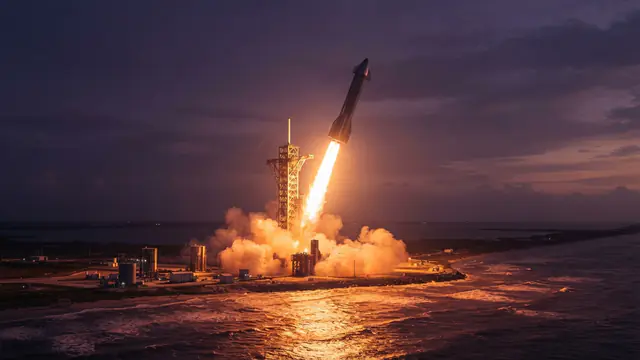
Japan Prepares MMX Launch to Retrieve First Martian Moon Samples
JAXA and international partners prepare to launch the MMX spacecraft on a five-year mission to collect samples from Phobos and observe Deimos.
In short
- The Japan Aerospace Exploration Agency (JAXA) scheduled the Martian Moons eXploration (MMX) mission to launch on an H3 rocket from Tanegashima Space Center.
- MMX aims to become the first mission to conduct a round trip to the Martian system, touching down on Phobos to collect at least 10 grams of soil.
- The spacecraft carries 13 instruments and the French-German rover IDEFIX, with target sample return to Australia scheduled for 2031.
The Japan Aerospace Exploration Agency (JAXA) is preparing to launch the Martian Moons eXploration (MMX) spacecraft on a historic mission to retrieve surface samples from Phobos, the larger of Mars' two moons. According to an announcement from JAXA, launch is scheduled aboard H3 Launch Vehicle Flight No. 10 at 4:41 a.m. JST on October 20, 2026 (19:41 GMT on October 19) from the Yoshinobu Launch Complex at the Tanegashima Space Center.
If successful, the five-year mission will mark the world's first sample return from the Martian system. The mission seeks to answer longstanding questions about the formation of the solar system, investigate the delivery of organic compounds and water to early rocky planets, and evaluate Phobos as a potential staging post for future human missions to Mars.
"The sampling from Phobos is of course the world's first, but it means this is the first round trip to the Martian system," MMX project manager Yasuhiro Kawakatsu told AFP via Phys.org. Kawakatsu added that Martian moons have never been fully investigated, describing them as "the most important unclimbed mountains in the solar system."

Spacecraft Architecture and the Journey to Mars
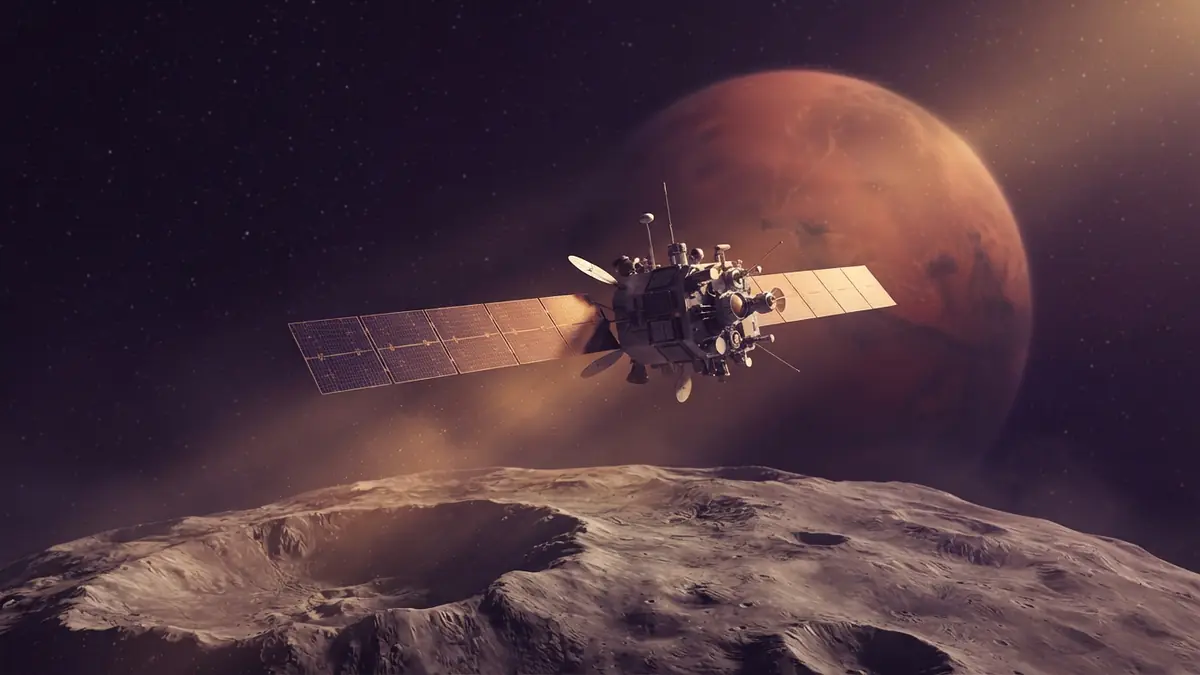
The MMX probe, built by Mitsubishi Electric, consists of three linked modules: a propulsion module, an exploration module, and a return module carrying a heat-shielded sample capsule. According to project manager Yasuhiro Kawakatsu via The Guardian, the flight path will cover an actual travel distance between 500 million and 600 million kilometers.
Following its 10-month cruise from Earth, MMX is scheduled to reach Martian orbit around August 2027. At that point, the spacecraft will discard its propulsion module and transition into a quasi-satellite orbit around Phobos. This trajectory enables the probe to fly in close formation with the irregularly shaped moon, which orbits Mars roughly 6,000 kilometers above the Martian surface three times every day.
MMX carries 13 scientific instruments developed in partnership with international agencies, including NASA, the European Space Agency (ESA), France's National Centre for Space Studies (CNES), and the German Aerospace Center (DLR). NASA contributed approximately $87 million to the effort, funding instruments such as the Mars-moon Exploration with Gamma rays and Neutrons (MEGANE) spectrometer and a pneumatic sampling device.
Surface Reconnaissance with the IDEFIX Rover
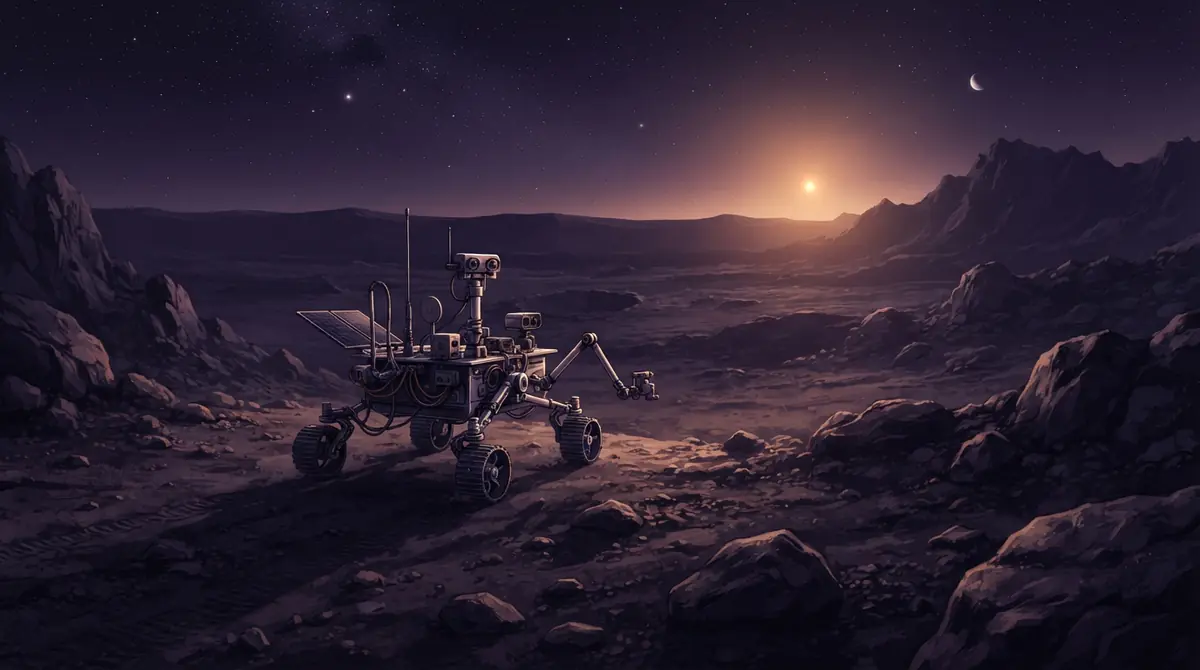
Before MMX descends to touch the low-gravity surface of Phobos, it will deploy a compact rover named IDEFIX, developed jointly by CNES and DLR. Named after the canine companion in the French comic "Asterix," the microwave-sized rover is scheduled to drop to the surface from a height of approximately 40 meters (130 feet) in late 2028 or early 2029.
Due to Phobos' gravity, which is roughly one two-thousandth of Earth's, IDEFIX is engineered to free-fall safely, bounce, right itself, and traverse the terrain at slow speeds. The rover carries a mini-radiometer (miniRAD) and the Raman Spectrometer for MMX (RAX) to study surface temperature and mineralogy during a planned 100-day expedition. Data from IDEFIX will allow mission operators to choose a safe, level touchdown site for the parent craft.
Dual Sampling Systems and Return Timeline
MMX's exploration and return modules will descend together to execute two separate landings on Phobos. Lindsay Hays, acting director of NASA's Planetary Science Division, stated during an October 15 briefing that sample collection could begin as early as December 2028, as reported by Space.com.
To ensure scientific recovery, MMX employs two independent collection mechanisms to gather at least 10 grams (0.35 ounces) of material:
- Pneumatic Sampling Mechanism (P-sampler): Built by Honeybee Robotics for NASA, this device fires pressurized gas to lift surface regolith into a collection canister.
- Corer Sampling Mechanism (C-sampler): Developed by JAXA, this tool drills approximately 2 centimeters into the subsurface to retrieve core soil.
JAXA scientists expect Martian ejecta—soil and rock blasted off Mars by historical asteroid impacts—to constitute roughly 0.1% of the material gathered from Phobos. Scientists say collecting samples from multiple locations increases the chances of obtaining any potential traces of past microbial life from Mars.
Following three years of operations around Phobos, MMX will adjust its trajectory into a resonant Mars orbit in 2030 to conduct observation flybys of Mars' smaller moon, Deimos. In late 2030, the exploration module will detach, allowing the return module to fire its engines out of Mars' gravitational well. The capsule is scheduled to land in the Woomera desert region of Australia in 2031, according to Space.com.

Unlocking Solar System Origins
Planetary scientists remain divided on the origin of Mars' moons, debating between the "capture" hypothesis and the "giant impact" hypothesis. The capture theory suggests Phobos and Deimos are primitive D-type asteroids drawn into orbit early in solar system history. Conversely, the impact model proposes that a large celestial body struck ancient Mars, ejecting a debris disk that coalesced into the two satellites.
"It's two totally different lines of evidence that point in two different directions," Tom Statler, MMX program executive at NASA, explained during the mission briefing. While the moons' spectral characteristics resemble asteroids, their circular and equatorial orbits align more closely with impact debris.
Laboratory isotopic analyses on Earth will measure elemental ratios that space-borne spectrometers cannot definitively verify. As outlined by Patrick Michel via Phys.org, discovering the origins of Phobos and Deimos will provide insight into the transport mechanisms that distributed water and volatile elements across the inner solar system, informing models of how habitable planetary environments evolved.
Broader Mars Sample Return Landscape
MMX enters service as international space agencies reassess Mars sample architectures. While NASA's Perseverance rover has collected Martian core samples, the prospective Mars Sample Return campaign faced severe setbacks when the Trump administration effectively canceled the effort following a congressional vote in January 2026, according to Phys.org.
Meanwhile, China has announced plans for its Tianwen-3 mission to launch around 2028, with the goal of returning surface samples from Mars as early as 2031. If MMX executes its timeline without delay, JAXA and its international partners may deliver the first physical specimens from the Martian system to terrestrial laboratories.
Questions people ask
What rocket is launching the MMX mission?
MMX is scheduled to launch aboard JAXA's H3 Launch Vehicle Flight No. 10 from the Tanegashima Space Center.
How much sample material does JAXA plan to collect from Phobos?
JAXA scientists aim to collect at least 10 grams (0.35 ounces) of regolith using two distinct sampling mechanisms developed by JAXA and NASA.
When are the Phobos samples scheduled to return to Earth?
The MMX sample return capsule is scheduled to land by parachute in the Woomera region of Australia in 2031.
What is the role of the IDEFIX rover on Phobos?
Jointly developed by France's CNES and Germany's DLR, the IDEFIX rover will test surface mobility, analyze composition, and provide topographical reconnaissance to assist MMX in selecting safe touchdown sites.
Sources
- Japan to launch world-first mission to collect samples from Martian moonThe Guardian, Oct 18, 2026
- Returning the first samples from a Martian moon: Inside the science of Japan's bold MMX mission to MarsSpace, Oct 18, 2026
- Japan to launch historic round-trip mission to Mars moonPhys.org, Oct 18, 2026
- Launch time of the Martian Moons eXploration (MMX) spacecraft aboard H3 Launch Vehicle Flight No.10global.jaxa.jp, Oct 18, 2026
- Martian Moons eXploration (MMX) | Spacecraft | ISASISAS
- Japan plans historic mission to explore Martian moonsdawn.com, Oct 19, 2026
How this story was made: the newsroom picked it up from phys.org, gathered the full text of the sources above, and drafted it with AI assistance. Every factual claim was then checked against those sources before publishing (24 claims checked). Illustrations marked as AI-generated are not photographs. Spotted an error? Tell us.
Published October 19, 2026 at 03:21 UTC