SpaceX Starship Reaches Orbit for the First Time on Flight 14
The world's largest rocket completed its first orbital insertion, deployed 26 Starlink V3 satellites, and splashed down in the Pacific after an abbreviated three-hour flight.
Key takeaways
- Starship reached Earth orbit for the first time during its 14th test flight from Starbase, Texas, achieving an altitude of approximately 275 kilometers.
- The spacecraft successfully deployed 26 next-generation Starlink V3 satellites, which SpaceX says adds 26 Tbps of constellation capacity.
- Despite an early Raptor engine shutdown during ascent, flight controllers completed orbital insertion before opting to conclude the mission after three hours instead of the planned ten.
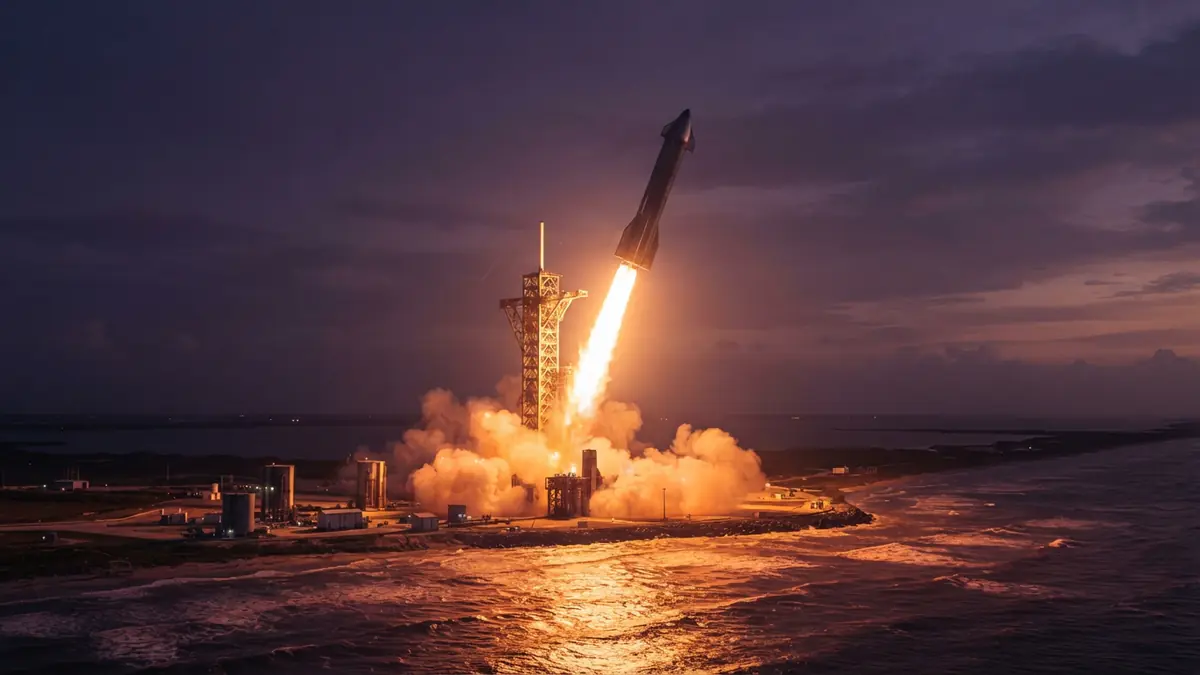
SpaceX reached orbit with its Starship megarocket for the first time on September 28, 2026, marking a pivotal milestone in the development of the world's tallest and most powerful launch system. The Flight 14 test vehicle lifted off from the company's Starbase facility in Boca Chica, Texas, at 8:48 a.m. EDT. During the flight, the upper stage achieved orbital insertion at an altitude of approximately 275 kilometers (170 miles) and deployed a batch of 26 next-generation Starlink V3 satellites before executing a deorbit burn and splashing down in the Pacific Ocean.
According to SpaceX's mission overview, previous flight tests intentionally flew passively safe suborbital trajectories to maximize public safety while allowing maximum learning. Flight 14 was specifically scheduled as the program's inaugural orbital test, intended to validate long-duration orbital coasting, payload deployment, and targeted deorbit maneuvers necessary for operational reuse.

Dramatic Ascent and Orbital Insertion
The Flight 14 mission sequence began with the ignition of Super Heavy Booster 21. At 2 minutes, 34 seconds into flight, the vehicle conducted hot-staging, firing the upper-stage engines to separate Ship 41 from the booster. Super Heavy executed a boostback burn and completed a controlled simulated landing burn over the Gulf of Mexico around seven minutes after launch, as reported by Space.com.
The upper stage faced unexpected friction during its climb to space when one of its six Raptor engines shut down prematurely. SpaceX spokespeople initially signaled that the orbital insertion burn would be called off. However, after technical evaluations confirmed the vehicle could safely reach velocity and retained sufficient redundancy for the deorbit burn, flight controllers approved the maneuver. At approximately 25 minutes after liftoff, Ship 41 ignited a single Raptor engine to circularize its orbit, as reported by Space.com, reaching roughly 28,000 km/h (17,500 mph), as reported by CBC News and CNET.
Starlink V3 Deployment and Heatshield Testing
Once established in low Earth orbit, Starship opened its payload bay to deploy 26 operational Starlink V3 satellites, completing release over a 30-minute window starting at T+34 minutes. According to SpaceX, each V3 satellite provides 1 Tbps of network capacity, totaling 26 Tbps for the mission—roughly ten times the capacity compared to a single Falcon 9 launch of V2 mini Starlink satellites. The satellites are scheduled to complete on-orbit checkouts and enter commercial service within several weeks.
Three of the deployed satellites carried specialized camera suites pointed back at Ship 41 to inspect its thermal protection system. Flight 14 incorporated multiple heatshield modifications based on hardware recovered from Flight 13 in the Indian Ocean, including supplemental tile retention mechanisms, curved tile sections in high-heat gaps, and two reused tiles from Ship 40—the first time SpaceX has reflown Starship thermal tiles.

Abbreviated Mission and Reentry Splashdown
SpaceX initially planned for Ship 41 to complete approximately six orbits over nearly ten hours before conducting a deorbit burn targeting waters off the coast of Chile. Roughly 1.5 hours into flight, mission controllers elected to truncate the test profile and bring the vehicle down earlier. As reported by CBC News, Starship returned early after completing two laps around Earth, executing a deorbit burn using a single Raptor engine according to Space.com.
Ship 41 entered the atmosphere over the Northern Pacific Ocean, transitioned through transonic and subsonic flight regimes, and performed a deceleration burn before touching down in the ocean north of Hawaii approximately 3 hours and 9 minutes after launch. Upon contact with the water, the spacecraft tipped over and exploded, concluding the test flight.
Why Orbital Capability Matters
Standing 407 feet (124 meters) tall, Starship is designed to carry more than 100 metric tons (110 tons) to low Earth orbit while achieving complete and rapid reusability, according to Space.com's technical coverage. Reaching orbit verifies the core flight mechanics required to support deep-space initiatives, commercial megaconstellations, and orbital infrastructure.
The orbital milestone directly impacts NASA's Artemis program. NASA selected Starship as a human landing system, with plans to demonstrate docking maneuvers between an Orion capsule and lunar landers during the Artemis III mission slated for mid-2027, followed by lunar surface landings on Artemis IV in 2028 or later, as detailed by CNET. NASA Administrator Jared Isaacman commended the Flight 14 milestone, highlighting SpaceX's progress in managing orbital test operations safely.
Frequently asked questions
How long did Starship Flight 14 remain in space?
The mission lasted 3 hours and 9 minutes from liftoff to splashdown, completing approximately two Earth orbits instead of the originally planned 10-hour, six-orbit itinerary.
What payload was deployed during the flight?
Starship successfully deployed 26 Starlink V3 satellites, each providing what SpaceX says is 1 Tbps of network capacity, including three camera-equipped units designed to photograph Starship's heatshield.
Where did the Super Heavy booster and Starship upper stage land?
Super Heavy conducted a simulated landing burn over the Gulf of Mexico, while the Ship 41 upper stage splashed down in the Northern Pacific Ocean north of Hawaii.
Sources
- Starship Flight 14 - SpaceXspacex.com · Sep 28, 2026 · Official
- SpaceX Starship Flight 14 live updates: Mission success!Space · Sep 23, 2026
- SpaceX’s Starship rocket reaches orbit for the first timeTechCrunch · Sep 28, 2026
- SpaceX launches Starship into orbit for 1st time — largest rocket ever built notches key milestone on dramatic…Space · Sep 28, 2026
- SpaceX sends giant Starship into orbit for the first time but ends the flight earlyCBC · Sep 28, 2026
- SpaceX's Starship reaches orbit for the first time, then returns early and blows up in a fiery explosionLive Science · Sep 28, 2026
- SpaceX Hits Major Milestone, Launching Starship Into Orbit for First TimeCNET · Sep 28, 2026
How this story was made: the newsroom picked it up from phys.org, Techmeme and Reddit, gathered the full text of the sources above, and drafted it with AI assistance. Every factual claim was then checked against those sources before publishing (29 claims checked). Illustrations marked as AI-generated are not photographs. Spotted an error? Tell us.
Published September 29, 2026 at 00:38 UTC