Nvidia Releases Flora to Slash Robotics Video Labeling Costs
Built on fine-tuned Qwen3.5 models, Flora handles temporal segmentation, captioning, and reward scoring at what Nvidia estimates is a fraction of commercial API costs.
In short
- Nvidia's GEAR lab introduced Flora, a three-model suite that automates action segmentation, captioning, and reward scoring for robot video data.
- Nvidia estimates Flora annotates an hour of manipulation footage for roughly $0.72 on GPU clusters, compared to about $88.50 using OpenAI's GPT-6 Astra.
- The models are fine-tuned from Qwen3.5 architectures and power data curation for Nvidia's GR00T foundation models, with Nvidia reporting an annotation throughput of 200,000 video hours per day on 512 GB300 GPUs.
- Flora excels at temporal boundary detection and failure identification, though GPT-6 Astra retains leads on robot-video captioning and rubric evaluations.
- The weights are available on Hugging Face under the Nvidia OneWay Noncommercial License, restricting use to noncommercial research and development.
Nvidia's GEAR lab has released Flora, an open-source suite of AI models designed to turn raw robot and human video recordings into structured training data. Introduced by researchers on October 20, 2026, the system automates the labor-intensive pipeline needed to train robotics foundation models by breaking videos into discrete actions, writing natural-language instructions, and evaluating task success. According to Nvidia's project page, Flora annotates video workloads roughly 125 times cheaper than commercial frontier models like OpenAI's GPT-6 Astra.
Robotics foundation models require vast amounts of annotated video to learn generalizable physical skills. However, commercial application programming interface (API) providers quickly become cost-prohibitive when processing tens of thousands of hours of demonstration footage. Nvidia reports that Flora is already running at scale to support its GR00T robotics models, achieving an annotation throughput of 200,000 hours of video per day across a production cluster of 512 GB300 GPUs.
Three Models Powering the Annotation Pipeline
Rather than relying on a single general-purpose multimodal system, the Flora architecture divides video annotation into three specialized stages: while Hugging Face model cards document the 27B models as derivatives of Qwen3.5-27B, reporting from The Decoder and eGamers confirms all three models in the suite are fine-tuned Qwen3.5 checkpoints. The suite includes a 9-billion-parameter model, Flora-TempSeg, alongside two 27-billion-parameter models, Flora-Captioner and Flora-Rewarder.
Flora-TempSeg first performs temporal segmentation, splitting continuous demonstration footage into localized action intervals. Once intervals are defined, Flora-Captioner analyzes the target window along with neighboring contextual frames to produce a concise imperative instruction describing the attempted physical manipulation. The model ingests either single-camera footage or synchronized three-camera mosaics combining main, left-wrist, and right-wrist viewpoints.
The final component, Flora-Rewarder, evaluates task execution depending on user prompts. It scores overall task success on a 1-to-5 scale, classifies individual half-second steps as normal, suboptimal, or failed, and measures performance against user-defined evaluation rubrics. As reported by Humanoids Daily, separating the intended goal from the execution quality allows reinforcement learning systems to learn from failed attempts without mistaking physical mistakes for intended tasks.
Cost Projections and Benchmark Comparisons
Nvidia claims Flora can annotate an hour of video for approximately $0.72, compared to an estimated $88.50 for GPT-6 Astra running with full reasoning enabled, according to reporting from The Decoder. Claude Opus 5 cost roughly $42 per hour in the same evaluation. However, Nvidia notes these cost figures represent projections based on an assumed cloud rental rate of $10 per GPU per hour across 50 sample videos, rather than verified production billing.
Performance evaluations show that while Flora offers massive compute savings, benchmark results between Flora and commercial alternatives remain nuanced. On the public WGO-Bench captioning benchmark, Flora achieved superior temporal localization and action boundary detection, but trailed GPT-6 Astra in overall score and fell behind Gemini 3.8 Flash in pure description accuracy. On Nvidia's internal DenseCaptionBench, Flora outperformed competing models across all human video metrics, though Astra placed ahead on robot manipulation footage.
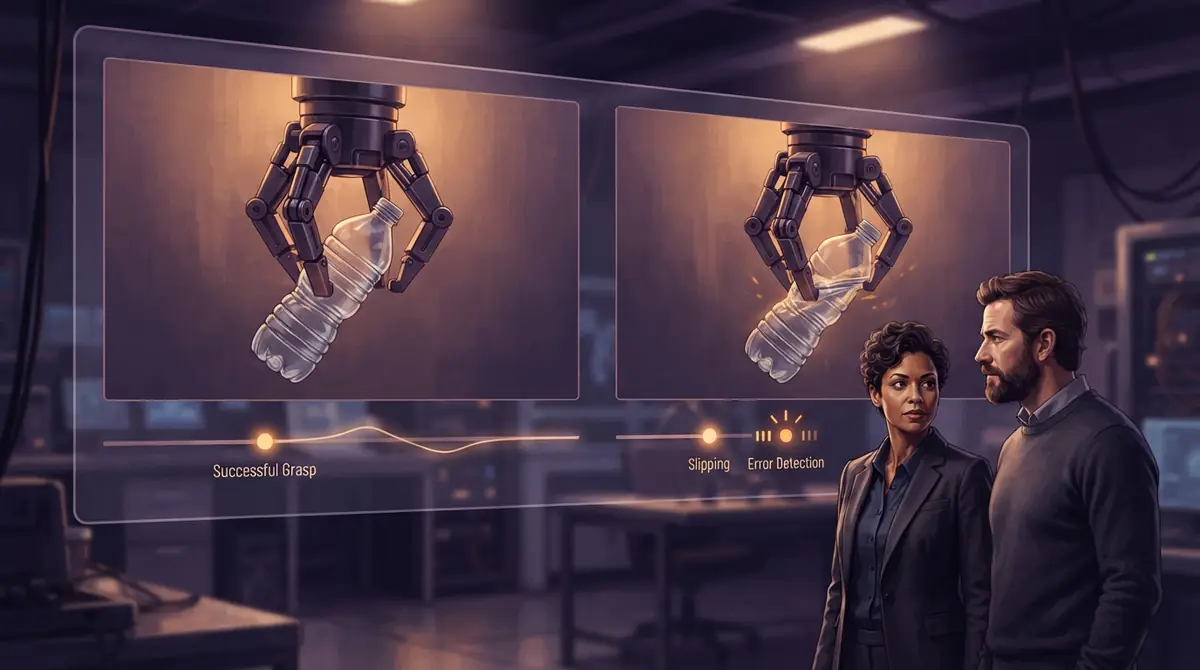
Flora demonstrates a distinct advantage in tracking intermediate errors. On the DenseRewardBench failure recall metric, Flora-Rewarder caught 53.3 percent of failed steps within an episode, whereas GPT-6 Astra caught none and no competing model exceeded 11.7 percent. On RoboRewardBench, Flora recorded a mean absolute error of 40.0, compared to 55.4 for Astra, largely because Flora appropriately assigned partial credit when robots partially completed tasks. The trade-off is precision: Flora falsely flagged approximately 11 percent of normal execution steps as errors, and Astra maintained leads in rubric-based scoring and trajectory ranking.
Availability, Licensing, and Industry Context
Nvidia has uploaded model weights for Flora-TempSeg, Flora-Captioner, and Flora-Rewarder to Hugging Face. Despite the open-model positioning, the models are governed by the Nvidia OneWay Noncommercial License, as detailed by robotico.market. The release restricts deployment strictly to noncommercial research and development, explicitly prohibiting direct commercial usage or standalone safety monitoring.
The release positions Flora as an open alternative to commercial offerings such as Scale AI's Physical AI Data Engine, as competitors like Google also advance robotics annotation pipelines such as Gemini 4 Argon, noted by eGamers.io. By lowering the computational overhead of video curation, Nvidia aims to empower academic and open-source labs to scale up custom physical datasets while reinforcing demand for its high-performance GPU hardware.
Questions people ask
What is Nvidia Flora?
Flora is an open-source model suite developed by Nvidia's GEAR research lab to automate the annotation of robot and human manipulation videos into structured training datasets.
How does Flora achieve lower labeling costs?
By fine-tuning specialized 9B and 27B Qwen3.5 models for temporal segmentation, captioning, and reward scoring, Flora runs on dedicated GPUs at an estimated $0.72 per video hour, compared to roughly $88.50 using GPT-6 Astra.
Can Flora directly control robotic hardware?
No. Flora produces descriptive text and reward evaluation annotations from video. It does not output motor commands and is not certified as a standalone safety monitor.
Is Nvidia Flora free for commercial deployment?
No. The Flora model weights are published under the Nvidia OneWay Noncommercial License, which restricts their application strictly to noncommercial research and development.
Sources
- Flora: An Open Model Suite for Scaling Robotics Data EnginesNVIDIA GEAR, official source
- nvidia/Flora-CaptionerHugging Face, Oct 1, 2026, official source
- Nvidia open-sources Flora to make robot video labeling 125x cheaper than GPT-6 AstraThe Decoder, Oct 25, 2026
- Nvidia's Open-source Flora Labels An Hour Of Robot Video For 72 Cents, Against About $88.50 On GPT-6eGamers.io – P2E NFT Games Portal, Oct 25, 2026
- NVIDIA Releases Flora Models to Turn Robot Videos Into Training Datarobotico.market, Oct 22, 2026
- NVIDIA Releases Flora to Turn Robot Videos Into Training DataHumanoids Daily, Oct 21, 2026
How this story was made: the newsroom picked it up from the-decoder.com, gathered the full text of the sources above, and drafted it with AI assistance. Every factual claim was then checked against those sources before publishing (19 claims checked). Illustrations marked as AI-generated are not photographs. Spotted an error? Tell us.
Published October 26, 2026 at 00:56 UTC