Columbia Researchers Trap Electron Waves in Metal Using Interference
By exploiting destructive quantum interference in a 2D metal, physicists observed bound states in the continuum for electrons, confirming century-old theory.
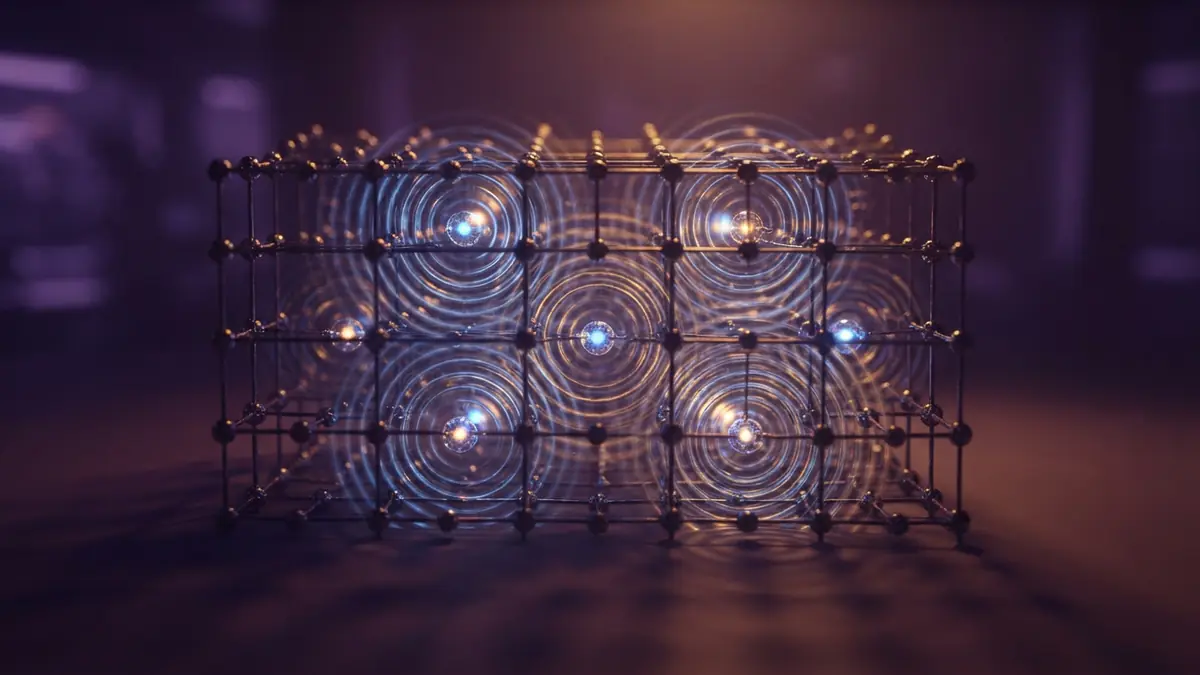
In short
- Columbia University physicists observed electron waves trapped in a metal, Pd5AlI2, for the first time.
- The trapping mechanism relies on destructive quantum interference, forming an electronic bound state in the continuum (BIC).
- The study, published in Science on October 22, 2026, confirms a theoretical prediction dating back nearly a century.
- Unlike semiconductors where doping traps electrons, metals can only localize electrons via BICs in frustrated lattice structures.
- The findings provide a pathway for developing sensitive quantum sensors and improving quantum computing hardware.
In a study published in Science on October 22, 2026, researchers at Columbia University reported successfully trapping electron waves inside a metal using quantum interference. The achievement, described in a paper titled "Electronic bound states in the continuum in a two-dimensional metal", demonstrates for the first time that electrons moving through a conducting material can be held stationary despite having open escape routes.
Classical physics treats conducting electrons in a metal like tiny spheres bouncing from point to point to carry current. In quantum mechanics, however, electrons behave as waves that ripple across a crystal and explore multiple paths simultaneously. When those wave paths intersect destructively, they can cancel each other out. The Columbia team demonstrated that this destructive interference can completely halt an electron wave, pinning it in place inside an otherwise conductive lattice.

Unlocking Bound States in the Continuum
When a wave is trapped even though infinitely many open states surround it, physicists call the phenomenon a bound state in the continuum (BIC). As reported by Mirage News, theoretical physicists first predicted the concept a century ago. Over the past decade, researchers managed to trap light waves by etching materials with tiny patterns, creating optical BICs that advanced lasing and nonlinear optics. An electronic BIC in a metal, however, had never been observed until now.
"Quantum mechanics predicts that an electron wave can, theoretically, remain trapped even when there are infinitely many paths for it to escape. This effect is known from light waves, but it has never been seen before for electrons," said Columbia theoretical physicist Raquel Queiroz, who formulated the models explaining the observations.
The metal responsible for the discovery is Pd5AlI2, synthesized several years ago in the Columbia chemistry laboratory of Xavier Roy. Pd5AlI2 is a layered metal that can be peeled down to two-dimensional sheets while retaining its metallic conductivity. Experimentalists noticed that electrons inside the compound traveled far more slowly than conventional theory predicted.
Frustrated Lattices and Quantum Interference
To understand the sluggish electron transport, Roy collaborated with Queiroz alongside Columbia experimental physicists Cory Dean and Aravind Devarakonda, an assistant professor of applied physics. According to the team's research published in Nature Physics last year and detailed in EurekAlert, electrons in Pd5AlI2 suffer from lattice frustration. The spatial orientation of the atoms and their electron orbitals gives an electron multiple conflicting routes to hop between sites. These competing pathways cancel out, restricting mobility.

Physicist Abhay Pasupathy examined the material using specialized atomic-scale scanning and spectroscopy tools at Columbia. During high-resolution imaging, the team detected unexpected stationary patterns. Further modeling by Queiroz revealed that these features were electron waves trapped near atomic lattice defects.
"Bound electrons shouldn't occur in a metal, but they do in Pd5AlI2," Queiroz said in the Columbia University announcement. "What we have observed is the first clear evidence of quantum interference trapping a state in a metal."
In conventional electronics and semiconductor chips, bound states are created through chemical doping, which governs how electric currents flow. A BIC is the only mechanism that allows an electron to remain localized inside a metallic sea, requiring materials with frustrated crystal lattices like Pd5AlI2.
Future Applications and Controlled Fabrication
Trapping quantum particles opens avenues for precise manipulation. "Trapping a wave is an idea as old as quantum mechanics itself, but it took almost a century to figure out how to do it with light. We have now realized it with electrons in a material," Roy noted in the EurekAlert report. "And if you trap a particle, you can manipulate it."
According to the researchers, electronic BICs could eventually aid in building highly sensitive quantum sensors, accelerating information transfer in quantum computing, and advancing quantum chemistry studies.
At present, the electronic BICs observed in the Columbia lab occur spontaneously around accidental defects created during crystal synthesis. Roy and Pasupathy are now working on methods to intentionally place defects at exact locations within the metal lattice. Such deterministic control would allow researchers to design and fine-tune specific interference patterns, establishing a practical template to discover similar quantum states in other frustrated metallic compounds.
Questions people ask
What is a bound state in the continuum (BIC)?
A bound state in the continuum is a wave state that remains localized and trapped in place even though it exists inside a continuous spectrum of surrounding states with open escape paths.
What material did the Columbia team use to trap electron waves?
The researchers used Pd5AlI2, a metal synthesized in Xavier Roy's laboratory that can be cleaved into two-dimensional layers while maintaining metallic properties.
How does quantum interference trap electrons in a metal?
The geometric arrangement of atoms and orbitals in Pd5AlI2 creates competing paths for electrons to hop. These paths interfere destructively, canceling each other out and trapping the electron wave near atomic defects.
Sources
- Quantum interference is key to catching electron wavesEurekAlert!
- Quantum Interference Helps Capture Electron WavesMirage News
How this story was made: the newsroom picked it up from phys.org, gathered the full text of the sources above, and drafted it with AI assistance. Every factual claim was then checked against those sources before publishing (20 claims checked). Illustrations marked as AI-generated are not photographs. Spotted an error? Tell us.
Published October 23, 2026 at 01:16 UTC