Gemini 4 Argon Helps Disprove 60-Year-Old Fusion Physics Conjecture
Researchers paired Google DeepMind's Gemini 4 Argon with physicists to discover explicit counterexamples to Harold Grad's 1967 plasma conjecture.
In short
- Google DeepMind researchers and physicist Matt Landreman used Gemini 4 Argon to generalize analytical solutions to magnetohydrodynamic equations that break stellarator symmetry.
- The analytical solutions refute Harold Grad's 1967 conjecture, which posited that smooth 3D plasma equilibria cannot exist without some kind of symmetry in the magnetic field.
- The new closed-form solutions provide exact benchmarks to verify simulation codes like VMEC, used by commercial fusion startups to design stellarator reactors.
Google DeepMind researchers, working alongside University of Maryland plasma physicist Matt Landreman, have uncovered analytical solutions that disprove a foundational 60-year-old hypothesis in nuclear fusion physics. The team used Google's Gemini 4 Argon running as autonomous agents to construct exact mathematical counterexamples to Harold Grad's 1967 conjecture on asymmetric magnetic plasma equilibrium, according to an arXiv preprint submitted on October 5, 2026.
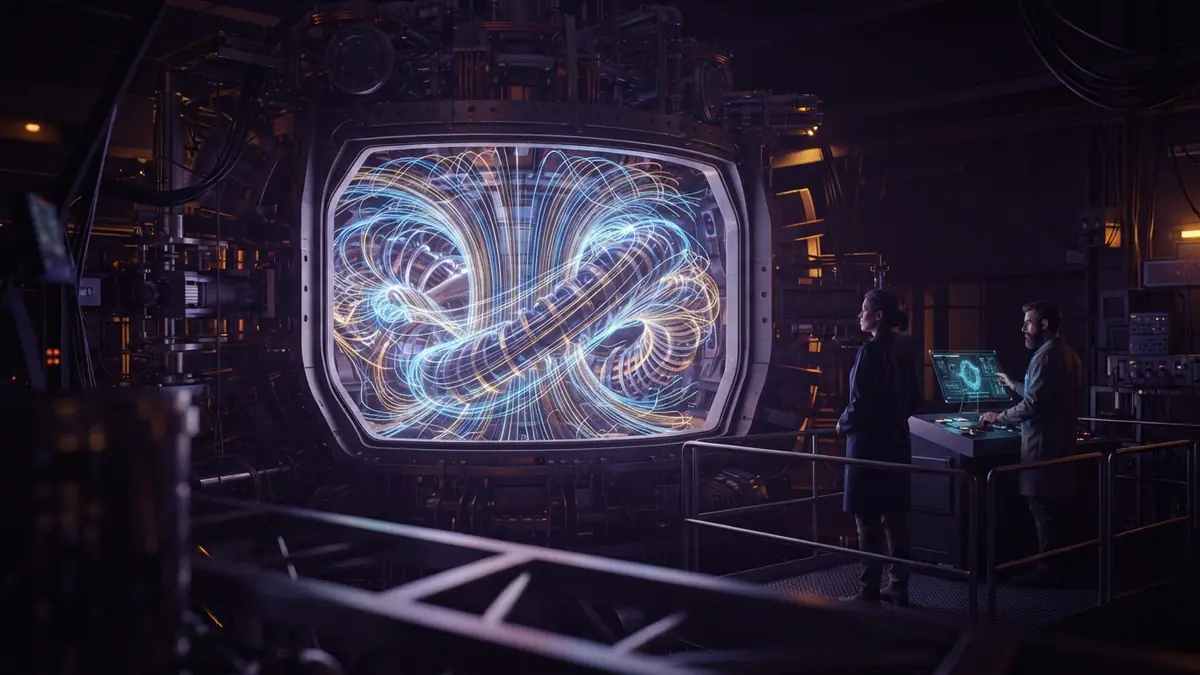
Grad, an applied mathematician and plasma physicist at New York University, conjectured in 1967 that smooth, three-dimensional magnetohydrodynamic (MHD) plasma equilibria cannot exist without spatial symmetry. For decades, that hypothesis stood as a theoretical ceiling over stellarators—fusion devices that confine burning plasma using complex, twisted three-dimensional magnetic fields rather than the symmetric doughnuts used in tokamaks.
The Fall of Grad's Conjecture
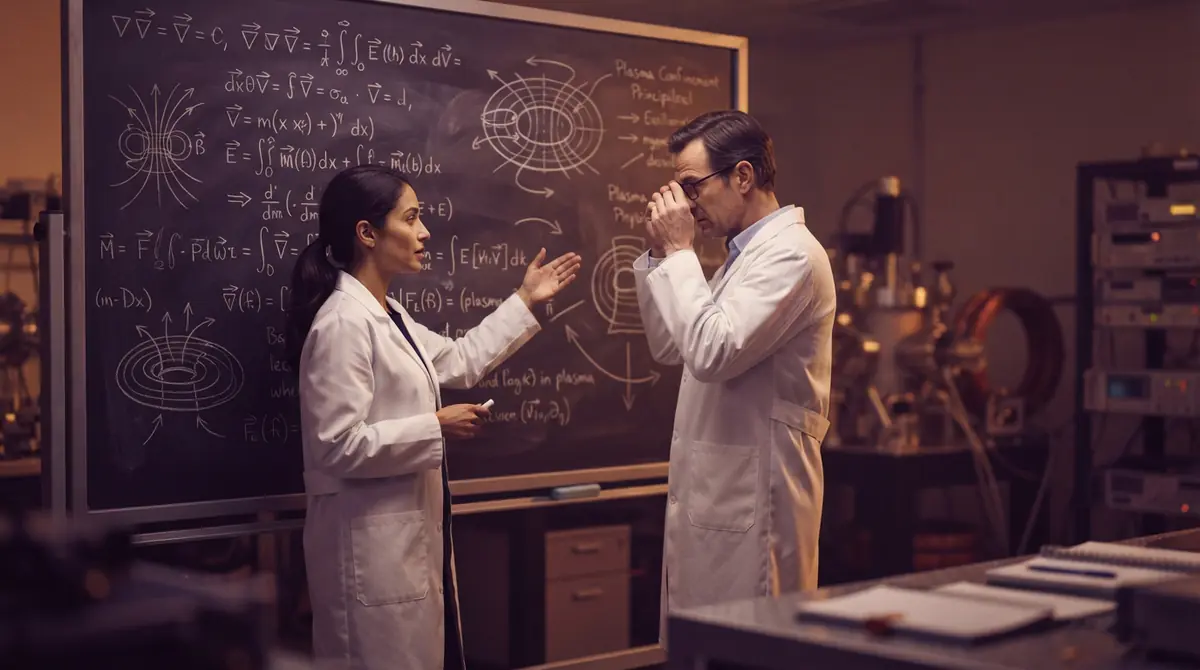
The breakthrough unfolded across several weeks in the autumn of 2026. On September 21, 2026, mathematicians Javier Gómez-Serrano, Lukas Liehr, and Mitchell Taylor published a Lean-certified proof demonstrating that smooth counterexamples to Grad's conjecture exist in theory, as detailed by MACCUS. The following day, Landreman posted explicit, closed-form solutions satisfying ideal MHD equations, discovered using OpenAI's GPT-6 Astra Pro with every equation verified by hand.
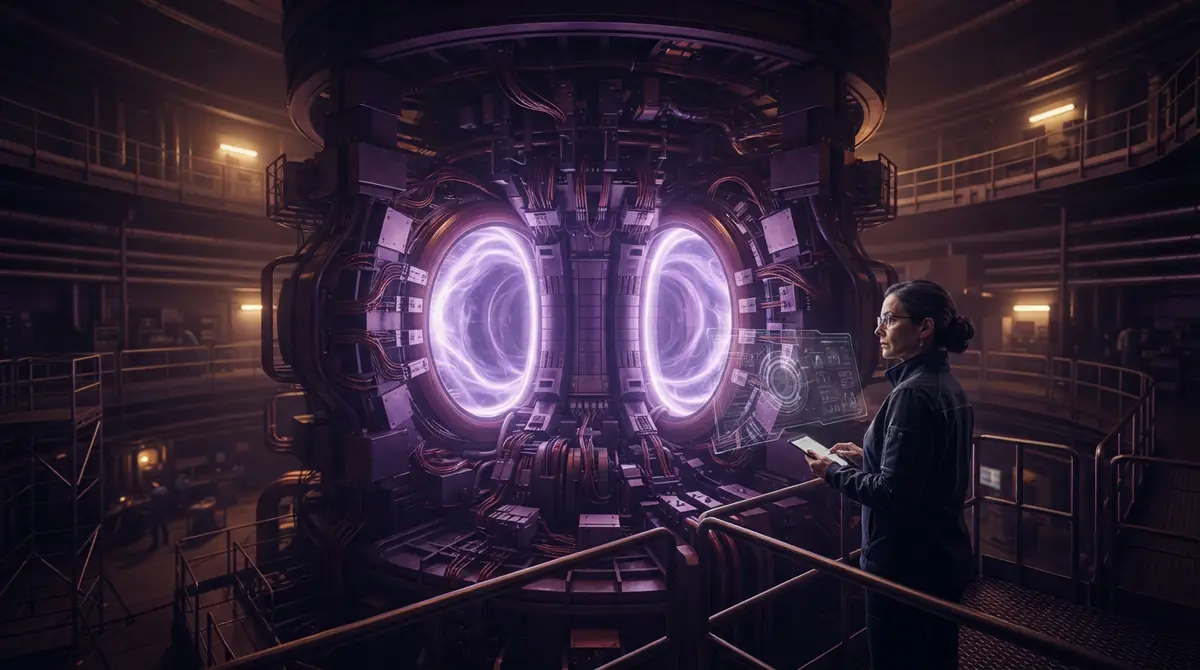
Landreman's initial solutions demonstrated nested magnetic surfaces without axisymmetry, but they remained constrained by stellarator symmetry. Thirteen days later, a Google DeepMind team including Jonathan Citrin paired with Landreman to generalize the equations. By deploying Gemini 4 Argon as a coordinated team of agents, the researchers introduced a symmetry-breaking parameter, producing broader solution families that eliminate stellarator symmetry entirely.
According to the authors of the arXiv paper, setting the symmetry-breaking parameter to zero cleanly recovers Landreman's original symmetric solutions, confirming the validity of the generalized system.
How Gemini 4 Argon Found the Solutions
Google officially unveiled Gemini 4 Argon on October 13, 2026, highlighting its multi-step reasoning capabilities in scientific discovery, software refactoring, and quantum computing. The company stated that the model operates at an introductory API pricing of $2 per million input tokens and $10 per million output tokens, with cached tokens discounted by 95%.
In the fusion project, the DeepMind team steered agentic loops to propose mathematical candidates that satisfied the ideal MHD equilibrium conditions: the force-balance equation $( abla imes \vec{B}) imes \vec{B} = abla p$ and the divergence-free magnetic field condition $ abla \cdot \vec{B} = 0$. Promising algebraic candidates appeared within hours, after which human researchers conducted adversarial reviews and re-derived every step by hand.
Why Exact Benchmarks Matter for Fusion Reactors
Stellarators represent an attractive route to commercial fusion because, unlike tokamaks which rely on axisymmetric fields, they use twisted magnetic fields and theoretically offer superior stability. However, designing their three-dimensional magnetic coils requires intense computation. Until now, reactor designers relied on numerical simulation solvers such as VMEC without having exact, non-symmetric closed-form equations to check their calculations against, as reported by Startup Fortune.
Without exact solutions, engineers were flying on faith that simulations converge on something physically real. Commercial ventures such as Commonwealth Fusion Systems and Type One Energy, which is building a stellarator demonstration reactor in Tennessee, rely heavily on simulation fidelity before spending hundreds of millions of dollars on hardware.
Having verified analytical solutions gives physicists fixed ground truth data. Simulation developers can now run standard numerical solvers against these known analytical fields to check whether simulation codes reach the correct answer.
Limits and What Comes Next
The resolution of Grad's conjecture does not instantly yield an operational fusion reactor. As researchers point out, confinement physics is only one part of the engineering challenge, alongside neutron-resilient materials, tritium breeding blankets, and power plant economics. Furthermore, Landreman noted that the question of whether non-axisymmetric equilibria can achieve exact quasisymmetry remains open.
To accelerate further research across academic disciplines, Google announced it is offering 10,000 scientists six months of free access to its highest usage tier in Google Antigravity. As symbolic computation tools and frontier AI agents integrate further into physics workflows, researchers now have mathematical proof that twisted magnetic confinement rests on solid ground.
Questions people ask
What was Harold Grad's 1967 conjecture?
Harold Grad conjectured that smooth, three-dimensional magnetohydrodynamic plasma equilibrium states cannot exist without some kind of symmetry in the magnetic field, which posed theoretical concerns for asymmetric stellarator fusion reactors.
What role did Gemini 4 Argon play in the discovery?
Google DeepMind researchers deployed Gemini 4 Argon as autonomous agents to explore mathematical candidates, discovering a symmetry-breaking parameter that extended known stellarator solutions into fully asymmetric equilibria.
How does disproving the conjecture help nuclear fusion development?
The discovery provides closed-form, analytical solutions that fusion physicists can use as exact ground-truth benchmarks to test and calibrate numerical stellarator simulation codes like VMEC.
Sources
- Analytic non-axisymmetric 3D MHD equilibria without stellarator symmetryarXiv.org, official source
- Gemini 4 Argon: Built to solve your hardest problemsGoogle, Oct 13, 2026, official source
- AI Resolves 59-Year Nuclear Fusion Conjecture: Technical Pathways and Future Prospectsintl.cloud.baidu.com, official source
- Google's Gemini AI helped disprove a 60 year old fusion physics conjectureStartup Fortune, Oct 17, 2026
- After math, physics: AI finds explicit counterexamples to a 1967 fusion conjectureMACCUS - SEO, Influence & Organic Marketing Agency, Oct 17, 2026
How this story was made: the newsroom picked it up from Google Search, gathered the full text of the sources above, and drafted it with AI assistance. Every factual claim was then checked against those sources before publishing (32 claims checked). Illustrations marked as AI-generated are not photographs. Spotted an error? Tell us.
Published October 18, 2026 at 01:45 UTC