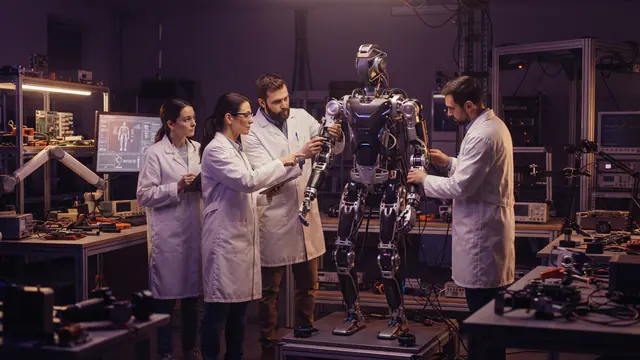
Brainobot Uses Living Human Brain Organoid to Guide Humanoid Robot
A biohybrid system called Brainobot uses three-dimensional living human neural tissue to process sensor inputs and guide robotic motor actions.

In short
- Researchers developed Brainobot, a biohybrid platform integrating a three-dimensional human brain organoid as the decision-maker for a humanoid robot.
- The organoid-driven robot performed closed-loop physical tasks, improving task accuracy from 72% to 94% across repetitive trials.
- Chemically inhibiting the cultured neurons caused robot performance to collapse, proving the biological tissue drove decision-making.
- The work was funded by the U.S. National Science Foundation and the National Institutes of Health.
In a study published as a bioRxiv preprint on September 15, 2026, an interdisciplinary research team revealed Brainobot, a biohybrid system that connects a lab-grown human brain organoid to a humanoid robot. Led by researchers including Chunhui Tian, Yang Yang, Lantao Liu, and Feng Guo, the project deploys cultured human neural tissue to act as a high-level decision-making layer, allowing a physical robot to perceive sensory signals and carry out real-world motor actions.
The development represents a functional demonstration of biological embodiment in robotics, as reported by bioRxiv. By translating camera inputs into electrical stimulation and decoding the tissue's neural responses into physical movement, the researchers established a closed-loop control system that relies on biological reservoir computing rather than standard software routines alone.
Architecture of a Living Brain Controller
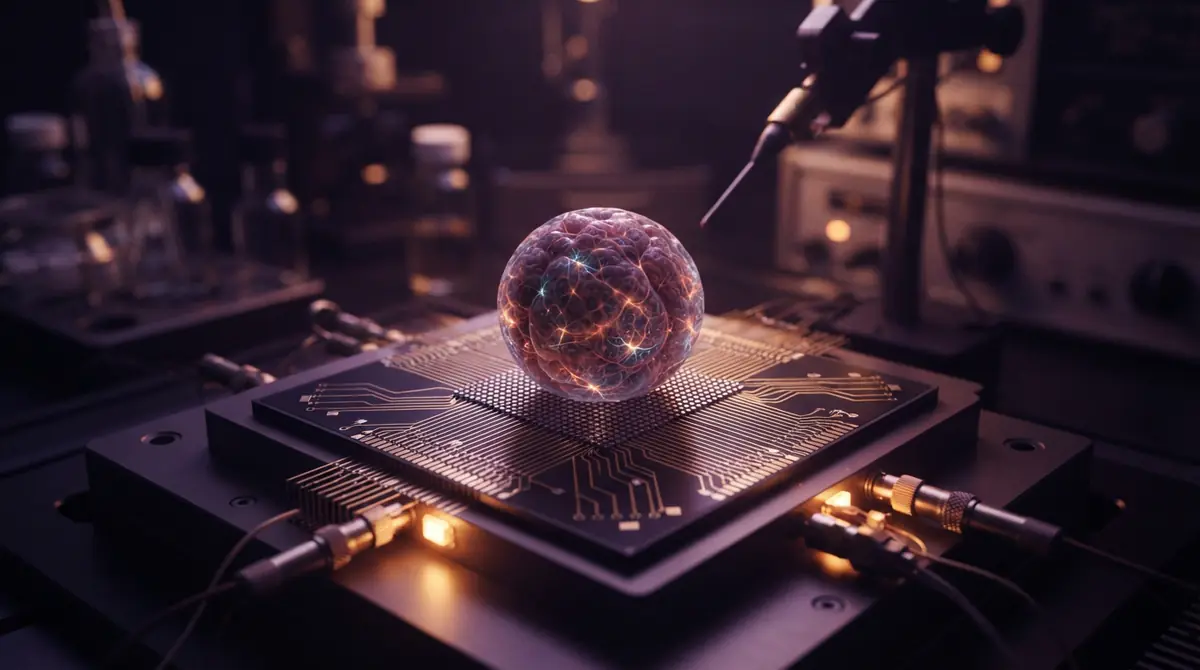
To construct the biological processor, researchers cultured human brain organoids from embryonic stem cells over approximately three months, according to coverage by Focal Points and SOTT. During this incubation window, the cells self-organized into three-dimensional structures containing networks of interconnected living neurons and supportive brain cells.
These 3D clusters function through a paradigm known as reservoir computing. Visual data from the robot's cameras is converted into electrical signals delivered to the living tissue, and the resulting neuronal activity is decoded into motor commands directing physical movement.
Object Grasping, Laser Chasing, and Accuracy Gains
The closed-loop architecture operates by streaming visual data from the humanoid robot's cameras directly into an interface that translates pixels into electrical impulses delivered to the living tissue. The resulting spikes in neuronal activity are then decoded into motor instructions directed to the robot's limbs.
In laboratory evaluations detailed by Lifeboat News, the humanoid robot completed physical benchmarks including grasping objects and tracking and chasing moving laser projections. Over repeated training sessions, the living neural network reorganized its internal activity, driving overall task accuracy from an initial 72% up to 94%.
To verify that the biological tissue was actively generating the commands rather than serving as a passive bystander to background code, researchers applied chemical inhibitors to the neurons. Following the chemical suppression, the robot's operational performance collapsed, confirming that living biological activity was necessary for the machine's motor execution.
Energy Efficiency and Biocomputing Frontiers
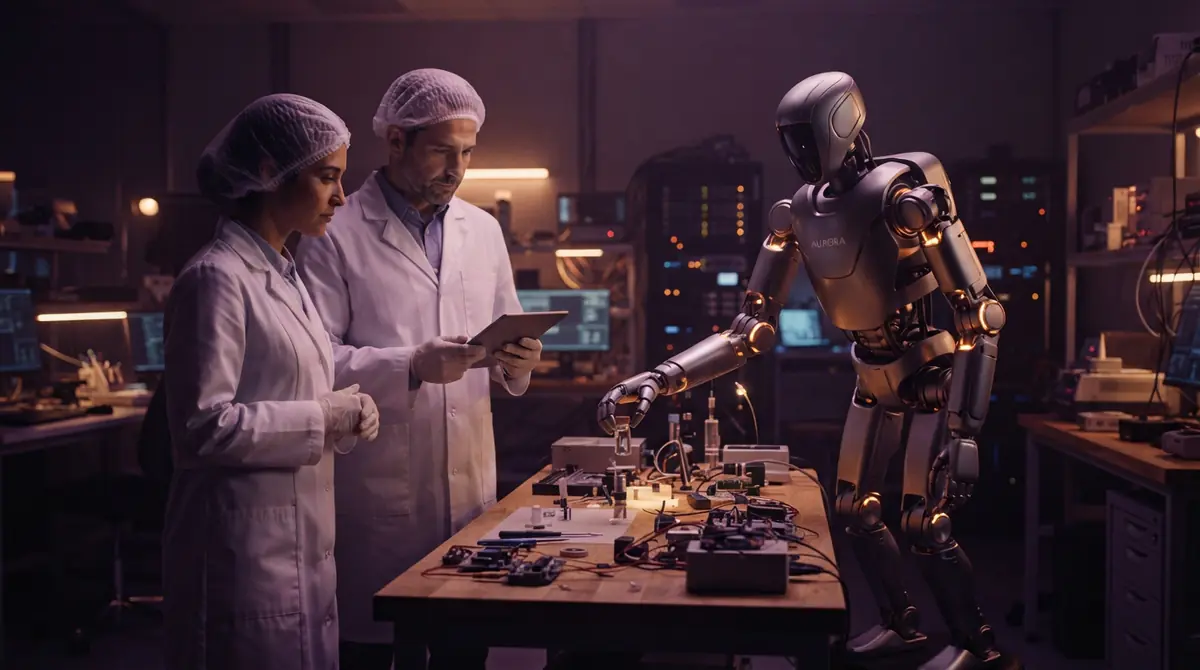
Biological computing systems present potential operating traits that differ sharply from silicon processors. Human brain tissue operates on minimal electrical wattage while demonstrating cross-task adaptability and rapid sample-efficient learning, attributes highlighted in previous biological computing demonstrations reported by New Atlas.
The authors of the Brainobot study observed that the organoid controller maintained low energy consumption while demonstrating computational efficiency and the capacity to adapt across different operational demands. During training, the living neural networks adapted and reorganized their activity to improve performance.
Technical Hurdles and Biological Limits
Despite the 94% benchmark, researchers and technical analyses emphasize that Brainobot remains an early proof of concept. The tasks demonstrated—laser chasing and object grasping—are basic compared to the multi-step reasoning executed by modern machine learning models and industrial robots.
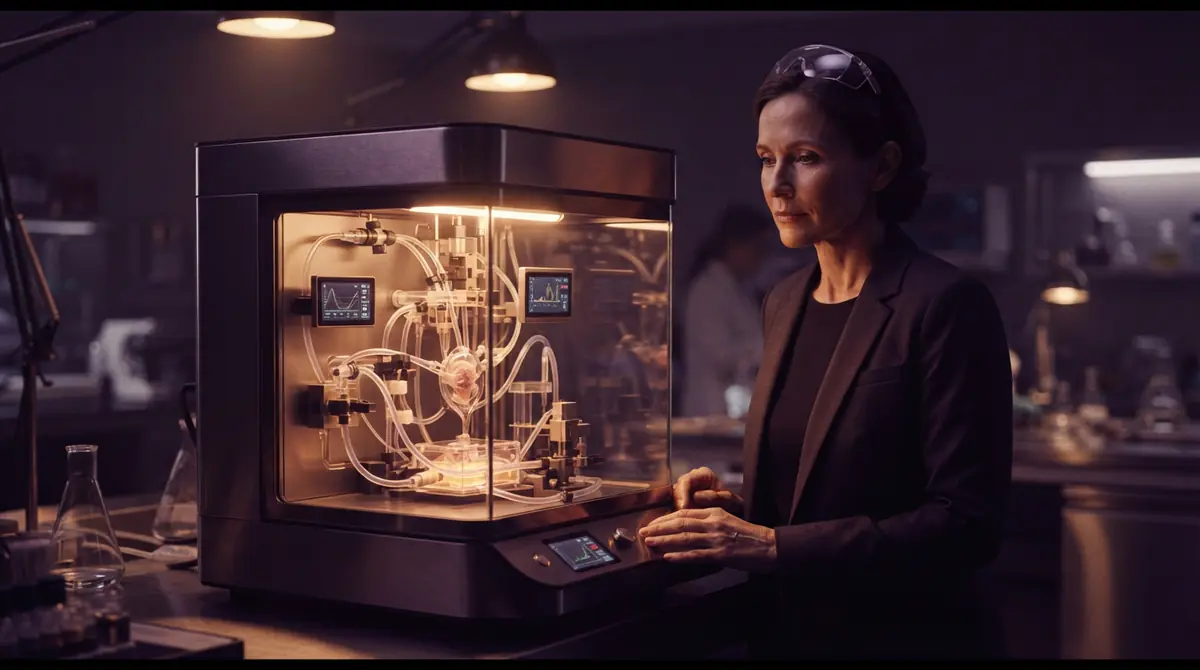
Operating living wetware inside or alongside hardware introduces major engineering constraints, as outlined by Lifeboat News. Organoids require dedicated life-support systems, including continuous nutrient perfusion, stable thermal management, and sterile isolation from pathogens to prevent cell death. Additionally, because organoids lack blood vessels, oxygen and nutrients cannot diffuse into tissue that exceeds microscopic dimensions, preventing simple physical scaling.
Biological variability also poses reproducibility hurdles. While silicon microchips can be mass-manufactured with near-identical physical geometries and predictable execution, living biological tissue is inherently variable and no two brain organoids grow exactly the same way. The emerging field also attracts ethical scrutiny regarding the moral status of cultured human neural tissues as biohybrid platforms gain operational complexity.
Research Support and Next Steps
The Brainobot study received backing from major U.S. scientific agencies. According to disclosures in the bioRxiv paper, the project was supported by the U.S. National Science Foundation under award EFRI2422149, alongside grants from the National Institutes of Health under awards U54AG090792 and R01GM160423.
The authors noted that the biohybrid platform serves a dual purpose: demonstrating new avenues for robotic embodiment while offering an experimental testbed to study how biological neural networks execute real-time decisions in dynamic physical environments.
Questions people ask
What is Brainobot?
Brainobot is an experimental biohybrid robotic system that uses a laboratory-grown human brain organoid as a biological decision-making controller for a humanoid robot.
How did researchers verify the living tissue was controlling the robot?
Researchers chemically inhibited the living neurons in the organoid; the robot's decision-making and motor performance immediately collapsed, confirming the tissue's active control.
What physical tasks did the robot perform?
The humanoid robot successfully performed real-world tasks including tracking and chasing a moving laser and grasping physical objects, reaching 94% task accuracy.
Sources
- Brain organoid computing for robotic decision-makingbioRxiv, Sep 15, 2026
- Brain organoid computing for robotic decision-making – Lifeboat News: The BlogLifeboat News: The Blog, Oct 23, 2026
- NIH-Funded Mad Scientists Have Created a Humanoid Robot Controlled by Living Human Brain Tissuesott.net, Oct 23, 2026
- 'Brain-in-a-jar' biocomputers can now learn to control robotsNew Atlas, Jul 1, 2024
How this story was made: the newsroom picked it up from Reddit, gathered the full text of the sources above, and drafted it with AI assistance. Every factual claim was then checked against those sources before publishing (20 claims checked). Illustrations marked as AI-generated are not photographs. Spotted an error? Tell us.
Published October 24, 2026 at 01:38 UTC