Apple Introduces HomeView, a $299 Smart Display Run by Siri AI
The 7-inch screen serves as a communal home hub, Matter controller, and Thread Border Router, leaning on an A18 chip and paired iPhones to surface personal context.
In short
- Apple unveiled HomeView, a 7-inch Liquid Retina smart display priced at $299, available November 13, 2026.
- The device runs on Apple's A18 chip, utilizing Secure Exclaves to run on-device facial and voice recognition for up to six household profiles.
- Siri AI provides conversational queries, recipe guidance, and smart home control, pulling personal context from paired iPhones on the local network.
- Hardware options include a tabletop edition with an acoustic base and a wall-mounted model, both supporting Matter and Thread Border Router protocols.
On October 13, 2026, Apple formally entered the dedicated home display market with HomeView, a 7-inch smart screen powered by the A18 processor and built specifically around the Siri AI assistant. Priced at $299, the device acts as a centralized smart home controller, Matter hub, and communication terminal, marking Apple's most direct effort to claim shared counter space in kitchens and living rooms alongside established offerings from Amazon and Google.
Pre-orders began immediately following the announcement, with in-store availability scheduled for November 13, 2026 across eight launch markets: the United States, United Kingdom, Canada, Australia, New Zealand, Singapore, South Africa, and India. The launch arrives alongside an updated Apple TV 4K and HomePod mini 2, anchoring a broader autumn expansion of Apple's connected hardware ecosystem.

Hardware Design and Display Specifications
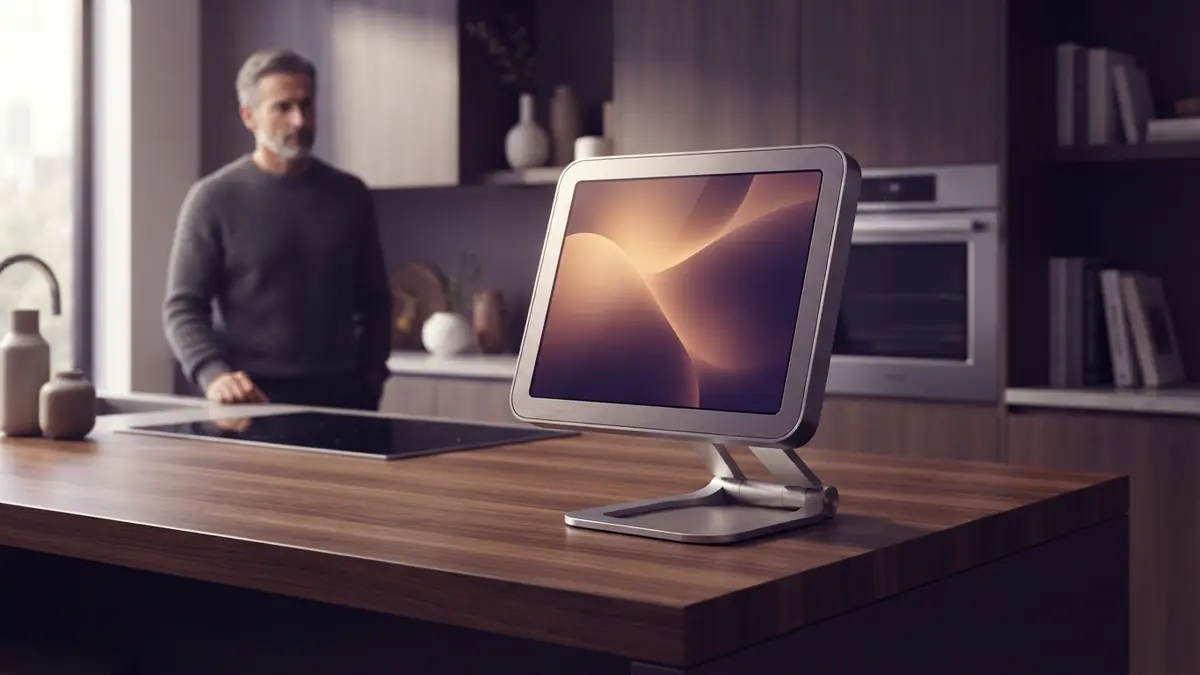
HomeView centers on a square 7-inch Liquid Retina display framed in aluminum, presenting a visual profile that resembles an enlarged Apple Watch, as reported by Engadget. The panel supports Apple's True Tone technology and ambient light sensing, reaching a peak brightness of 500 nits and dropping as low as 0.3 nits—the lowest floor Apple has engineered on any display to date—to minimize disruption when placed in bedrooms.
The hardware is devoid of physical buttons, relying entirely on capacitive touch and voice commands. Two models share the identical $299 price tag: a tabletop configuration and a wall-mounted variant. The tabletop version mounts the screen onto a compact aluminum base via an adjustable stainless steel hinge. This base houses a down-firing woofer and two force-canceling passive radiators to reinforce the two full-range drivers built directly into the display casing. The wall-mounted version omits the desktop base and offers three power configurations—standard plug-in, in-wall power, or in-wall Power over Ethernet (PoE)—with computational audio tuned specifically for flush-wall acoustics.
Both versions arrive in four finishes: Silver, Starlight, Rose Pink, and Space Gray. For visual communications, the upper frame integrates a 12-megapixel camera supporting Center Stage, which automatically adjusts framing during FaceTime video calls as occupants move around the room. A four-microphone array manages noise isolation and voice capture for hands-free interactions.
Siri AI and On-Device Identity Management
Software capabilities on HomeView center on Siri AI, the upgraded conversational assistant powered by Apple Intelligence that introduced broader contextual understanding in iOS 27. According to The Verge, Siri AI on the display handles complex natural-language tasks, multi-step queries, and context retention across household requests, such as adding calendar events and updating shared shopping lists in succession.
To balance communal accessibility with personal security, HomeView implements multi-user recognition for up to six household members. The system uses the A18 processor's Secure Exclaves to run camera-based facial recognition and voice matching in an isolated hardware partition. Apple states that visual and acoustic sensor data used to verify identity remains sealed inside these enclaves, inaccessible to third-party applications, the primary operating system, or Apple's servers.
When a recognized user approaches the screen, HomeView authenticates their profile provided their Apple Intelligence-capable iPhone or iPad is on the same local Wi-Fi network and was recently unlocked. Once verified, the interface surfaces private calendar entries, unread messages, and personalized music suggestions. If an unverified person or guest approaches, personal data locks immediately, while base functions like smart home controls, kitchen timers, and weather updates remain active.
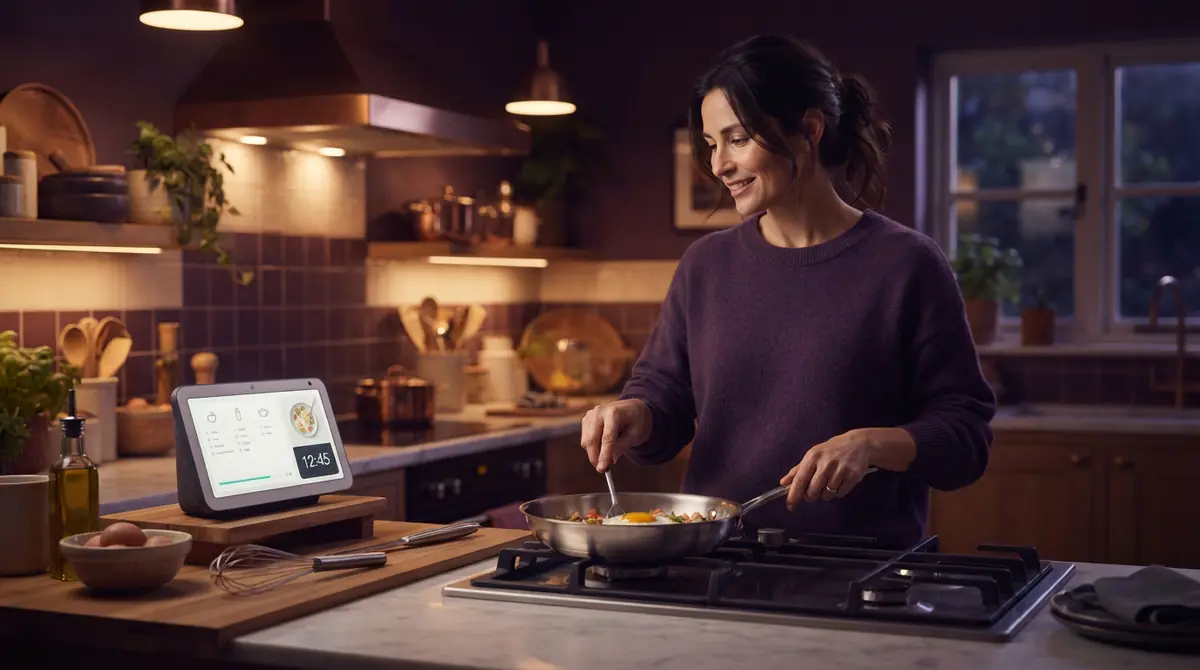
Software integration also extends to Safari, which introduces a dedicated cooking mode. When users navigate to structured online recipes, HomeView presents a distraction-free, step-by-step layout with touch and voice-driven timers. Native iOS apps such as Reminders, Calendar, and Music populate customizable home widgets, and the device supports third-party audio apps built on the CarPlay architecture, including Spotify and Audible.
Smart Home Coordination and the Ecosystem Strategy
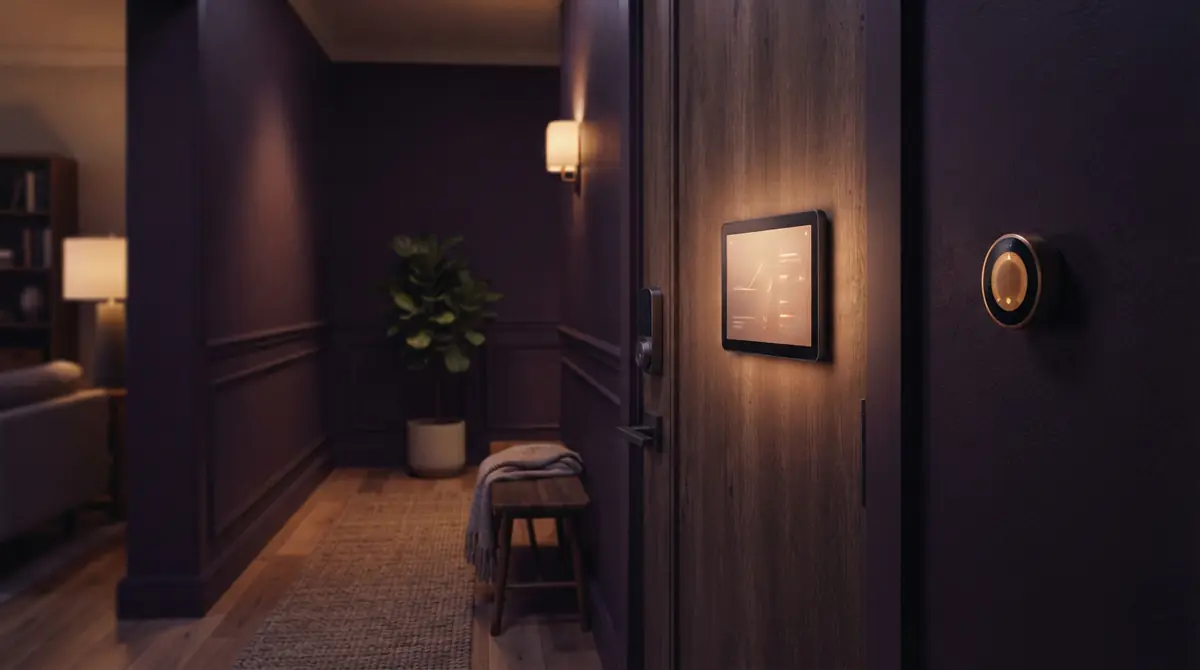
Beyond communications and media playback, HomeView functions as an Apple Home Hub, Matter controller, and Thread Border Router. The interface includes specialized watch-style modular faces and camera grids capable of streaming up to nine live HomeKit Secure Video feeds simultaneously, according to Apple's product specifications. Built-in acoustic sensing also alerts paired Apple devices if smoke or carbon monoxide detectors sound.
To accompany the display, Apple announced the Apple Home Collection, a set of smart home accessories built in partnership with LG and Schneider Electric. The collection includes indoor and outdoor security cameras, a video doorbell, a smart door lock, and connected thermostats, with individual component prices ranging between $199 and $349. These accessories pair via proximity detection cards similar to the AirPods setup flow, allowing users to orchestrate routines, review automated security summaries, and unlock entrances directly from the HomeView panel.
HomeView represents Apple's effort to untether household management from personal phones while preserving the personal data safeguards established on iOS. Whether consumers choose to install a communal display dependent on nearby authenticated iPhones will become clearer when retail units reach homes this November.
Questions people ask
What is the price and release date of Apple HomeView?
HomeView costs $299 for either the tabletop or wall-mounted edition. Pre-orders opened October 13, 2026, with shipments and store availability starting November 13, 2026.
What hardware powers Apple HomeView?
The device features an A18 chip with Secure Exclaves, a 7-inch Liquid Retina display (0.3 to 500 nits brightness), a 12-megapixel Center Stage camera, and built-in Spatial Audio speakers.
How does HomeView protect personal privacy in a shared household?
The display supports up to six user profiles using facial and voice recognition processed locally in the A18's Secure Exclaves. Personal data like messages and calendars only appears if the user's paired iPhone or iPad has been recently unlocked on the same Wi-Fi network.
Can HomeView control third-party smart home devices?
Yes. HomeView functions as a Matter controller and Thread Border Router, enabling touch and Siri AI control over compatible accessories from Apple Home and third-party manufacturers.
Sources
- Apple unveils the new Apple TV 4K, supercharged by Siri AIApple Newsroom, Oct 13, 2026, official source
- Apple HomeViewApple, official source
- Apple Unveils HomeView, The Company's Smart Display Built For Siri AIEngadget, Oct 13, 2026
- Apple launches HomeView, its first smart display for the homeThe Verge, Oct 13, 2026
How this story was made: the newsroom picked it up from Google Search, Hacker News and Techmeme, gathered the full text of the sources above, and drafted it with AI assistance. Every factual claim was then checked against those sources before publishing (36 claims checked). Illustrations marked as AI-generated are not photographs. Spotted an error? Tell us.
Published October 14, 2026 at 00:13 UTC