Research Claims 90% of AI Neurons Are Legible, Upending Superposition
A preliminary audit of large models suggests most artificial neurons perform identifiable jobs, questioning long-held assumptions about polysemanticity.
In short
- Goodfire researcher Nick Cammarata published an essay on October 15, 2026, arguing that neural networks are largely monosemantic rather than hopelessly tangled.
- A preliminary audit of Qwen3-32B found about 90 percent of neuron poles have one primary function, with similar patterns reported up to trillion-parameter models like Kimi K3.
- The findings challenge the prevailing superposition hypothesis and suggest autonomous AI agents can interpret model circuitry directly at scale.
- Prominent researchers, including Google DeepMind interpretability lead Neel Nanda, caution that the technical companion paper has not yet been released and question whether weak activations were adequately accounted for.
On October 15, 2026, Nick Cammarata, a researcher at interpretability startup Goodfire and formerly of OpenAI, published an essay titled "Neural Networks Are Already Clean." Cammarata argues that the longstanding belief that neural networks are inscrutable tangles of unrelated concepts is incorrect. According to his findings, roughly 90 percent of neurons in modern large models have distinct, identifiable roles, a revelation that could simplify the task of auditing internal model behavior for deception and safety risks.
The essay challenges the dominant paradigm in mechanistic interpretability, which assumes models rely heavily on "polysemanticity" and "superposition." Under that hypothesis, artificial neural networks pack multiple unrelated concepts into single neurons to maximize limited dimensional capacity. In response, laboratories such as Anthropic and Google DeepMind have dedicated significant effort toward training secondary models, like sparse autoencoders, to untangle these activations. Cammarata contends that much of this complexity was an artifact of older architectures and underpowered inspection methods, according to The Decoder.
The Shift From 2% to 90% Legibility
Cammarata previously co-authored foundational mechanistic interpretability papers, including the 2020 "Zoom In" research with Chris Olah that helped introduce superposition circuits. In 2023, while at OpenAI, he led an automated interpretability project where only about 1.7 to 2 percent of neurons were found to be understandable even under forgiving criteria.
By contrast, preliminary audits reported in Cammarata's October 2026 essay show a dramatic difference. In an evaluation of the open-weight model Qwen3-32B, approximately 90 percent of neuron poles performed a single dominant function. Another 7 percent handled two closely related tasks, leaving just 2 to 4 percent unexplained, as outlined in an analysis by explainx.ai. Goodfire reports observing comparable legibility across architectures scaling up to trillions of parameters, including the Kimi K3 model, as noted by HyperAI.
To explain why previous researchers saw chaotic overlaps, Cammarata re-examined canonical examples of polysemanticity. In the classic vision model InceptionV1, neuron 4e:55 famously responded to both cat faces and car fronts. Cammarata found that the neuron is actually a detector for sharp, outward V-shapes. It fires when encountering pointed forms like fox snouts, flames, and water jets from boats, while driving its activation negative on round "O" shapes. Rather than packing unrelated semantic concepts together, the neuron tracks a consistent geometric primitive.
Recursive Generalization and Automated Agents
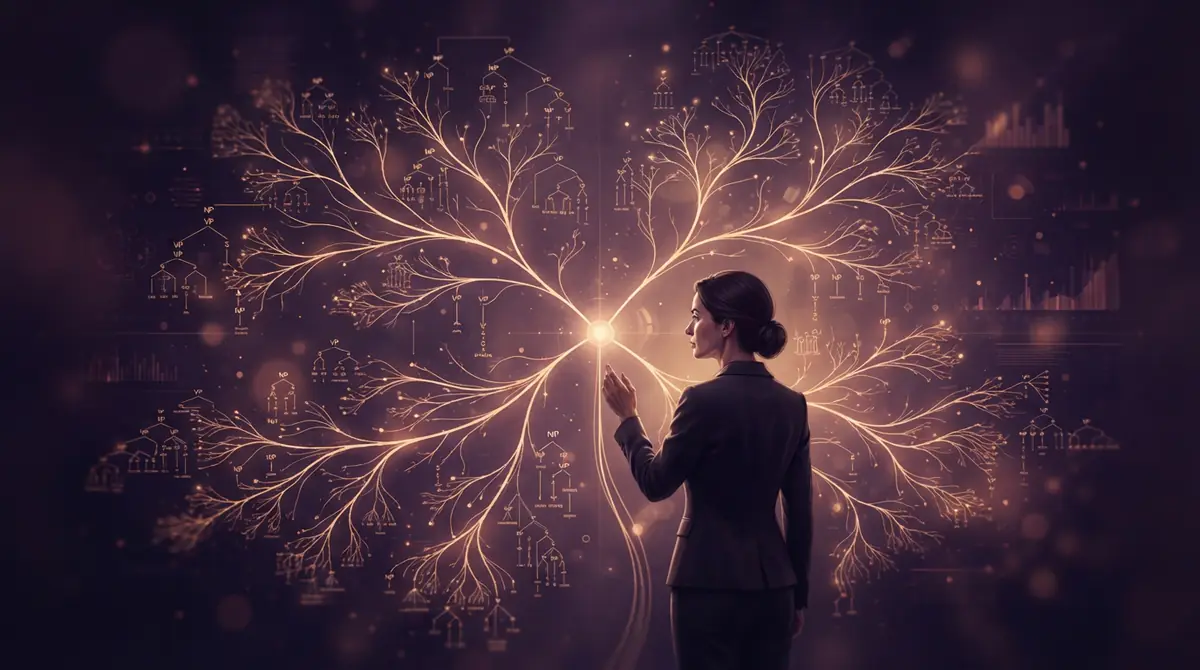
Where neurons do display multiple related behaviors, Cammarata attributes the phenomenon to "recursive generalization" rather than arbitrary superposition. In this process, a neuron behaves like a branch that sprouts sub-branches over time. For example, a language neuron initially activating on the string sequence "iy" expanded its responses to "diy" and eventually fired on the full semantic concept "do it yourself," which contains no literal "iy" characters. Because these offshoots share an underlying conceptual link, they remain structured and legible.
The research was conducted using autonomous AI agents that analyzed neurons en masse. Rather than relying on human researchers to hand-label individual weights, Goodfire deployed agents to observe activations, generate functional hypotheses, inspect upstream and downstream circuits, and design validation tests. In a blind trial across 200 neurons, an independent agent generated test inputs based on another agent's functional descriptions; 76 percent of the predicted positive inputs triggered strong activations in the target neurons, with false positives occurring in only 11 percent of cases, according to reporting by HyperAI. The team also reviewed approximately 100,000 attribution graphs to trace information routing.
Borrowing from computer scientist Rich Sutton's "Bitter Lesson," Cammarata argues that brute-force investigation using scalable AI agents outpaces clever, handcrafted decomposition methods like sparse autoencoders, as summarized by Latent.Space.
Community Reaction and Practical Caveats
The essay has sparked intense debate across the AI safety and alignment community. OpenAI researcher Roon praised the work on social media, writing that it may represent a milestone that helps transform alignment into a normal, empirical science. Proponents argue that if frontier models are already legible, safety engineers can directly inspect internal circuits to detect deceptive behaviors or hidden reasoning, rather than treating models as opaque black boxes, according to Crypto Briefing.
However, other interpretability researchers have voiced strong reservations. Neel Nanda, who leads the interpretability team at Google DeepMind, cautioned that the core problem of superposition remains unresolved. Nanda argued that language models store vastly more factual knowledge than they have neurons, meaning concepts must still overlap within subtle, low-magnitude activations that coarse audits might overlook. Nanda also suggested the essay might be defining monosemanticity too loosely, as reported by The Decoder.
Among other researchers, Pfau noted the paper itself is not yet out, while Leo Gao argued explanations should be judged by neuron simulation measured with KL. Furthermore, Goodfire is a commercial company selling model interpretability tooling, which observers note gives the firm an incentive to promote optimistic timelines. Until independent research teams replicate the agentic audits across diverse open and proprietary model weights, whether neural networks are truly clean remains an open scientific question.
Questions people ask
What is polysemanticity in neural networks?
Polysemanticity refers to an artificial neuron activating in response to multiple unrelated concepts, such as a single neuron firing for both cat faces and car grills.
What did Nick Cammarata find in Qwen3-32B?
A preliminary audit indicated that roughly 90 percent of neuron poles have a single primary function, about 7 percent have two related functions, and only 2 to 4 percent remain unexplained.
Why do some researchers disagree with the findings?
Researchers such as Google DeepMind's Neel Nanda argue that models hold more facts than neurons, meaning superposition is likely still present in weak activations, and note that the formal companion paper has not yet been published.
Sources
- [AINews] Agents disprove Polysemanticity; greatly improve Interpretability & AlignmentLatent.Space, Oct 16, 2026
- Is AI interpretability close to a breakthrough? A new essay has researchers dividedThe Decoder, Oct 16, 2026
- Is AI interpretability close to a breakthrough? A new essay has researchers divided哲见 · WISE AI, Oct 16, 2026
- Former OpenAI researcher Nick Cammarata says most AI neurons are now interpretableCrypto Briefing, Oct 16, 2026
- HyperAIHyperAI
- Goodfire: Neural Networks Are Already Clean, Claim Checked | explainx.ai Blog | explainx.aiexplainx.ai, Oct 15, 2026
How this story was made: the newsroom picked it up from Techmeme, latent.space and Reddit, gathered the full text of the sources above, and drafted it with AI assistance. Every factual claim was then checked against those sources before publishing (32 claims checked). Illustrations marked as AI-generated are not photographs. Spotted an error? Tell us.
Published October 17, 2026 at 01:09 UTC